1 min read
"Dad, I'm Using This New Number Now": What To Do? [A Complete Guide]
How Emotional Manipulation Drives Mobile Scams "Hi Dad” scams, also known as “Hi Mum” scams, are a type of authorized fraud (scam). These scams...

9 min read
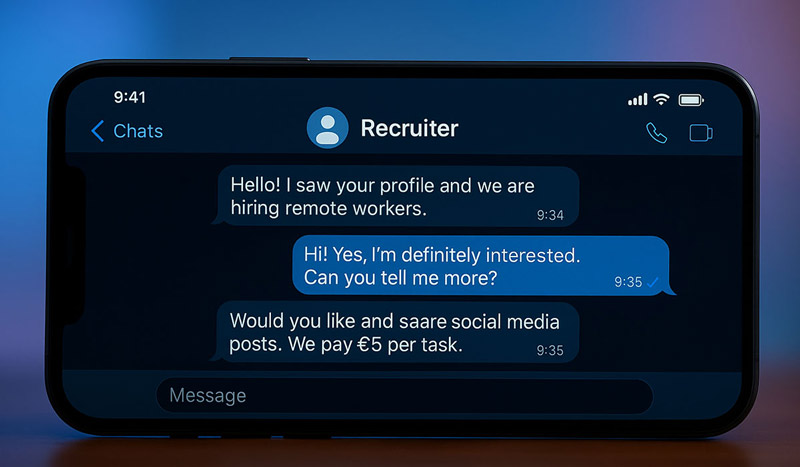
Fake job scams often deceive individuals into becoming both victims and unwitting money mules. Criminals typically pose as legitimate employers, using convincing recruitment processes and promises of flexible, well-paid online work to gain their trust.
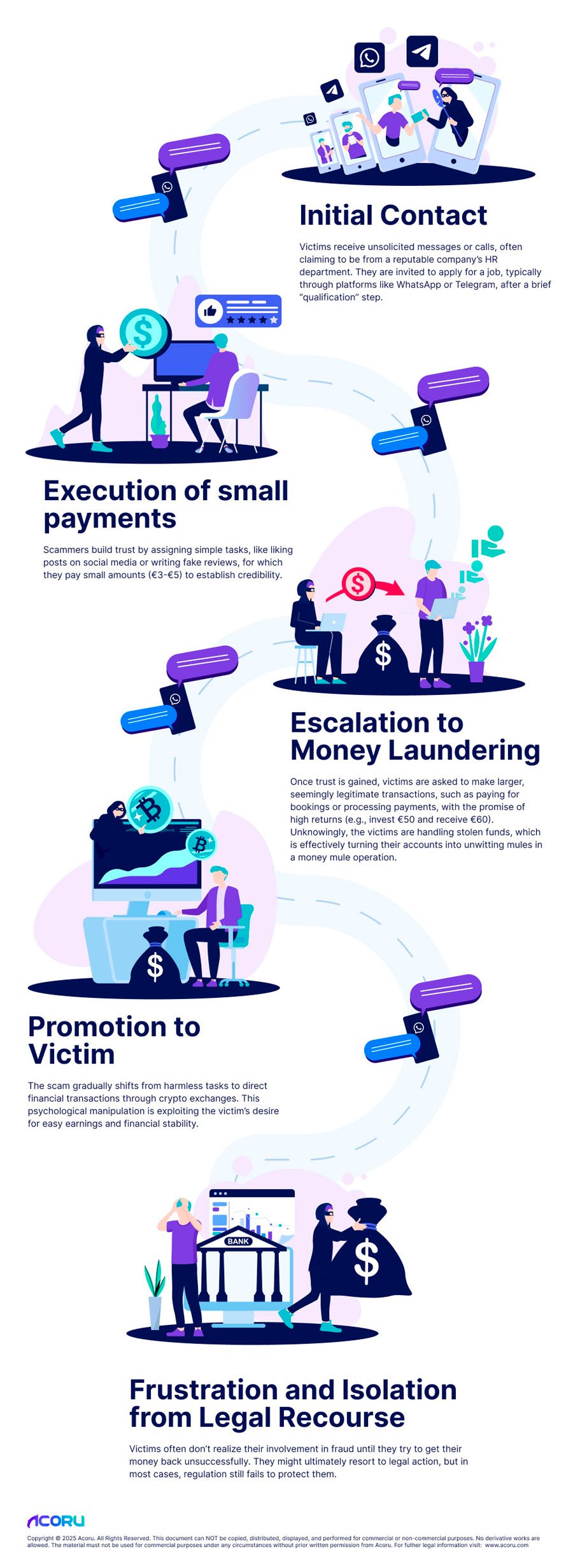
The below illustrates the common stages of a typical fake job scam:
Fake job scams have evolved alongside changes in technology and the labor market. During the 19th century, fraudsters exploited migrants by charging fees for nonexistent jobs or transport. As recruitment became more organized, scams expanded to include fake employment agencies and telemarketing schemes demanding upfront payments.
The rise of the internet, online job boards, social media, and remote work accelerated this evolution. According to the US Federal Trade Commission, reported losses from job-related scams increased from $90 million in 2020 to $501 million in 2024, highlighting the rapid growth of this type of fraud.
Today, fraudsters use sophisticated tactics such as fake job listings, cloned company websites, synthetic identities, and AI-generated interviews to create highly convincing recruitment experiences. What began as relatively simple employment fraud has evolved into a technology-driven scam that not only targets victims directly but also recruits unwitting money mules to support wider criminal networks.
So why have fake job scams become such an attractive model for fraudsters?

The following analysis evaluates fake job scams across four key dimensions using a 0–10 scale (0 = very low, 10 = very high).
Modern fake job scams require minimal upfront investment. Scammers often utilize free or low-cost tools to perpetrate their schemes:
In some cases, scammers may invest in more sophisticated setups, such as cloned websites or AI-generated content, but these are exceptions rather than the norm.
The risk of apprehension for scammers is relatively low due to several factors:
However, when scams involve substantial amounts or high-profile victims, law enforcement agencies may prioritize investigations, increasing the risk for perpetrators.
Fake Job Scams have a high success rate due to:
Moreover, despite being digitally savvy, individuals from younger generations are more susceptible to job scams due to overconfidence in digital spaces, financial pressures, high social media exposure, and limited job market experience.
The ROI for job scams is exceptionally high:
Job Scams offer a very attractive return on investment for fraudsters.
| Category | Score (/10) | Key Insights | |
| 1 | Initial Investment |  Very Low · 2/10 |
Minimal setup costs using free or inexpensive tools |
| 2 | Exposure Risk |  Low · 3/10 |
Low risk due to anonymity and cross-border challenges |
| 3 | Success Rate |  High · 8/10 |
High effectiveness through emotional manipulation and credible impersonation |
| 4 | Return on Investment |  Very High · 9/10 |
Significant financial gains with minimal expenditure |
The combination of minimal setup costs, low exposure risk, high success rates, and exceptional scalability makes fake job scams one of the most attractive fraud models for organized criminal networks.
Not every fake job scam looks like a job at all. A large and growing share now take the form of task scams, gamified micro-task platforms where victims are paid small amounts for simple actions like rating products, liking videos, or "optimising" listings. Early payouts are real and arrive quickly, which is what makes the format so effective: trust builds fast, well before the first request to "top up" an account to unlock a bigger commission.
In the US, task-style scams accounted for around 40% of all job-scam reports to the FTC in the first half of 2024 alone, with cryptocurrency losses from job scams reaching $41 million in the same six-month period. Because task scams rarely involve a fake "employer" in the traditional sense, they're also harder for job seekers to recognize as scams and harder for banks to flag using recruitment-fraud indicators, since the account activity looks more like a series of small deposits than a classic advance-fee request.

Fake job scams are expensive for banks precisely because they're invisible to the controls already in place. The login is genuine, the device is recognized, and the payment is authorized by the real account holder, which means a transaction that later turns out to be scam-related or mule-related can pass every existing unauthorized-fraud check without triggering a single alert. From a financial institution's perspective, fake job scams present several unique detection challenges. Unlike many other fraud typologies, these scams often generate few conventional fraud signals, making them difficult to identify before financial losses occur.
Some of the key challenges include:
To effectively track the lifecycle of an account and anticipate potential misuse, robust account classification is crucial. By categorizing accounts based on their typical behavior, financial institutions can better detect subtle shifts that might indicate emerging risks. This approach allows for continuous assessment, even when signals are weak or fragmented.
However, simply relying on classification isn’t enough. It is equally important to maintain a vigilant watch on all available signals, including those that might typically be dismissed as false positives. Early detection requires a holistic view of account activity, from transaction patterns to digital behavior, ensuring that potential scams are intercepted before they escalate into significant threats.
The following real-world examples demonstrate how fake job scams continue to affect victims across different countries and industries. Despite differences in tactics, each case follows the same underlying objective: convincing victims to transfer money or unknowingly participate in fraudulent activity.

A 26-year-old woman named Rachael fell victim to a job task scam where she was offered an online, commission-based role. Initially, she received small refunds, leading her to believe the job was legitimate. However, when she refused to pay more, the scammers became hostile and threatened her, stating they had her personal information. She lost £7,995 before realizing it was a scam.
Martin Carroll, a 64-year-old IT expert from Queensland, lost $25,000 in a job scam just two years before his planned retirement. He was lured by a fake job opportunity that promised weekly payments for filling online shopping baskets. Despite initial skepticism, he was encouraged by a WhatsApp group and started working for a company called Ruri. He paid for items, expecting reimbursement and commission, but only received one payout. The scammers then introduced high-cost “special buys,” leading Carroll to spend more money. Realizing it was a scam, Carroll quit but had already lost his savings.


In December 2024, the National Police arrested a 23-year-old woman in Jerez de la Frontera, accused of defrauding 1,580 euros through fake job offers in the name of a well-known sports retail chain. The suspect sent emails impersonating the company, asking victims to make payments for “administrative procedures”, which she promised to reimburse once the position was secured. Two young individuals fell for the scam. The fraudster was charged with fraud and identity theft.
Monika Zytowiecka, a 38-year-old business owner from Southampton, lost nearly £4,000 in a single day after falling prey to a cryptocurrency scam promoted as an online side hustle on Facebook. The scam initially promised earnings of up to £250 a day for processing online orders. She was instructed to make online orders using a budget, assured of refunds with added commission. Initially, she received her money back with commission, gaining her trust. However, she was asked to make increasingly larger top-ups, leading to nearly £4,000 being lost when the sales platform and scammers disappeared.

These cases represent only a small proportion of fake job scams occurring worldwide. Many victims never report their losses due to embarrassment, fear, or limited opportunities to recover stolen funds. As a result, the true scale of fake job scams is likely far greater than official figures suggest.

Fake job scams have evolved into sophisticated fraud operations that combine psychological manipulation, professional recruitment tactics, and increasingly advanced technologies to exploit job seekers. Beyond the financial losses they cause, these scams also recruit unwitting money mules, allowing organized criminal networks to expand their operations.
For financial institutions, preventing fake job scams requires more than monitoring individual transactions. Detecting behavioral changes, continuously classifying accounts, and correlating pre-fraud signals across the customer lifecycle are essential to identifying emerging risks before a transaction is initiated.
As fraud techniques continue to evolve, organizations that adopt a proactive, intelligence-led approach will be better positioned to detect fake job scams earlier, protect customers, and disrupt criminal networks before significant losses occur.
Discover how Acoru helps financial institutions identify pre-fraud signals, detect emerging money mule activity, and prevent authorized fraud. Contact our team to learn more.
A fake job scam is a form of authorized fraud in which criminals pose as legitimate employers to steal money or personal information, or to recruit victims, knowingly or unknowingly, as money mules who move stolen funds on their behalf.
Many fake job scams ask victims to receive a payment and forward it on, framed as a routine part of the "job", processing an order, issuing a refund, or passing on a commission. The victim believes they're working; in reality, they're moving the proceeds of a separate scam, which is what makes them a money mule.
A witting mule knows, or strongly suspects, that the funds they're moving are illegitimate. An unwitting mule genuinely believes they're doing legitimate work, which is the more common outcome of a fake job scam, and the harder case for banks to act on fairly.
Reported losses vary widely by region and scam type but are large and rising: in the US, reported job-scam losses grew from $90 million in 2020 to $501 million in 2024, according to the FTC. Actual losses are widely believed to be higher, since a large share of victims never report.
Younger adults are disproportionately affected. In the UK, people under 30 account for roughly 64% of cases indicating money mule activity on the Cifas National Fraud Database, and job offers remain one of the most common recruitment tactics used to reach them.
Yes, but only by treating the account, not the single payment, as the unit of analysis. Pre-fraud signals such as a sudden change in payee patterns, an unusual test payment, or a profile edit shortly before a large transfer, tracked over the account's full lifecycle, can flag the shift from regular activity to victim to mule before the largest transfer is ever attempted.

1 min read
How Emotional Manipulation Drives Mobile Scams "Hi Dad” scams, also known as “Hi Mum” scams, are a type of authorized fraud (scam). These scams...

1 min read
What are Crypto Scams? Crypto scams are a type of investment fraud where criminals use the mechanics and mystique of cryptocurrency to deceive...

1 min read
What are Bank Impersonation Scams? A bank impersonation scam is a type of financial institution impersonation scam in which fraudsters pose as a...