1 min read
Fraud Detection in Banking: Everything You Need to Know
Banks analyze payments in real time, apply rules to identify suspicious activity, and intervene when a transaction appears fraudulent. But what if ...

8 min read
In the banking industry, fraud often starts long before any payment is made, sometimes even weeks before any losses can be detected. For that reason, fraud prevention in banking increasingly relies on assessing behavior and risk signals across channels over time.
Fraud losses in global banking are on track to jump 153%, from $23 billion in 2025 to $58.3 billion by 2030. And the threat keeps changing shape. As banks harden defenses against one fraud type, criminals move to the next: In 2024, UK authorized push payment losses fell 2% while unauthorized cases rose 14%. Fraud didn't shrink. It moved.
That is the limit of fighting fraud, one type at a time. The earliest signals appear across accounts and channels, often weeks before a transaction is initiated.
In this article, you'll learn everything about fraud prevention in the banking industry so you can minimize fraud losses, strengthen compliance, and build a more resilient defense strategy against emerging threats.
Transaction monitoring fires at the payment, after the fraud is in motion. By then, the victim is groomed, and the mule is ready to receive. Continuous account monitoring, risk-based authentication, and AI classification intervene before a transaction is initiated.
Fraudsters often attack multiple institutions using the same tactics. Combining AI-driven risk scoring with cross-institution intelligence allows banks to spot emerging threats faster and reduce false positives.
Fraud signals are scattered across digital banking and mobile apps, assisted channels like call centers, IVR, and branches, and payment channels including ATMs, POS, card-not-present, and P2P, as well as external enrichment sources. Connecting them gives banks a complete view of account risk rather than a fragmented view by channel.
Acoru reads pre-fraud signals before any transaction exists: new payees, profile and limit changes, channel switching, test micro-payments, and reconnaissance logins. Analyzed continuously across channels and counterparties, they let Acoru classify accounts and surface mule networks and scams before a transaction is initiated.
Fraud prevention is the proactive use of policies, technologies, and best practices designed to reduce the likelihood of fraud. These measures include:
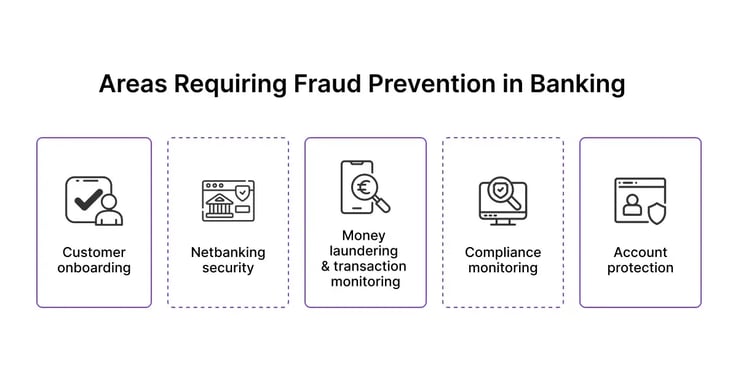
Banks and financial institutions face a wide range of fraud threats. Below are some of the most common types of fraud, along with descriptions of how they operate.
Authorized push payment (APP) fraud happens when scammers manipulate victims into authorizing transfers directly from their bank accounts using real-time payment systems. Because the payment is approved by the account holder, banks typically have no reason to block it.
In 2024, total APP fraud losses in the UK declined by 2% from the year before, to just over £450 million, and the number of cases dropped by 20%. However, while this type of fraud is becoming less common, the average loss value per case has increased from £606 in 2020 to £663 in 2024.
Money mule fraud involves criminals recruiting individuals to receive and transfer illicit funds through their bank accounts. By moving money through multiple accounts, mule networks make it harder to trace its origin, which increases the risk of large-scale money laundering.
In 2024, 257 financial institutions across 21 countries reported nearly 2 million money mule accounts.
Synthetic identity fraud occurs when criminals create fictitious identities by combining genuine personal information, such as Social Security numbers, with fabricated details like names, addresses, or employment records.
Once established, these synthetic identities are used to open accounts, build credit histories, and eventually commit fraud through loan defaults or large withdrawals.
Identity fraud and account takeover (ATO) involve the unauthorized use of personal information or compromised credentials to open new accounts, access existing ones, and conduct fraudulent transactions. Studies show that:
Check fraud involves the use of stolen, altered, or counterfeit checks to obtain funds or make unauthorized payments.
Although check usage has declined, checks remain an attractive target because they are relatively easy to intercept and manipulate. A Federal Reserve survey found that 63% of respondents experienced attempted or actual check fraud in 2024.
Effective fraud prevention requires a comprehensive approach that combines technology, strong policies, employee awareness, and collaboration. Below are some of the most effective fraud prevention strategies you can implement.
Many fraud prevention programs focus on transactions, overlooking the broader account activity that provides important context for fraud detection.
Continuous account-level monitoring helps you detect suspicious patterns by identifying changes in customer behavior and account activity throughout the customer journey.
To support continuous account-level monitoring, look for solutions that can help you:
Worth knowing:
Acoru continuously tracks pre-fraud signals across the customer journey, including:
Although MFA significantly reduces the risk of unauthorized account access, it cannot stop fraud when legitimate customers complete authentication themselves.
Instead of applying the same authentication challenge to every customer, you should adapt authentication based on continuous account risk, pre-fraud signals, and cross-channel context.
To do this, you need tools that help you:
Worth knowing:
Acoru scores and classifies each account before the customer confirms a transaction, prior to 2FA or SCA. This provides a risk read before authentication to match the level of verification to the account's current risk instead of challenging every customer the same way. Its Predictive Challenge Analytics draw on challenge, device, session, and behavioral signals.
Traditional intelligence-sharing typically relies on static blacklists and raw indicators such as:
While valuable, these indicators become outdated quickly, lack behavioral context, and cannot distinguish between different levels of account risk, such as an unwitting mule account vs a complicit one.
A more advanced approach is to share dynamic account risk classifications using zero-knowledge techniques, allowing banks to gain cross-institutional context without pooling raw customer data.
Worth knowing:
Acoru's Consortium Manager enables financial institutions to collaborate through a real-time, privacy-preserving intelligence network. Rather than relying on static blacklists, it helps you share actionable fraud insights and continuously improve fraud and mule account detection without exposing customer data.
Acoru analyzes accounts across three coverage levels: your own accounts (Level 1), the external accounts your customers transact with (Level 2), and external accounts with no relationship to your customers, reached through optional consortium sharing (Level 3).
Here is what it does:
Request a demo today and learn how Acoru can help you stay ahead of emerging fraud threats.
AI has become a core component of modern fraud prevention, with 91% of US banks already using it for this purpose.
AI is now core to fraud prevention, and the banks pulling ahead use it to read accounts, not just transactions. Static rules catch known patterns. They miss the slow, cross-channel buildup that precedes a scam or a mule cash-out. Continuous, AI-driven risk scoring closes that gap. It spots unusual behavior earlier, focuses analysts on the highest-risk accounts, and cuts false positives.
Here is what to look for:
Worth knowing:
Acoru is AI-native, not analytics bolted onto a rules engine. It scores accounts on continuous behavior and pre-fraud signals, not point-of-transaction events. Its AI capabilities include:
Many fraud incidents originate from within organizations. By separating responsibilities among multiple employees, you reduce the likelihood that a single person can initiate, conceal, and benefit from fraudulent activity.
To implement stronger internal controls, you should:
Worth knowing:
To learn more about the past, present, and future of fraud prevention, watch what Acoru CEO Pablo de la Riva has to say on the topic.
Fraud signals often emerge hours, days, or even weeks before a transaction is initiated, making point-in-time decisions insufficient for detecting scams, authorized fraud, and money mule activity. This is where Acoru can help.
Unlike traditional fraud tools that focus on transactions, logins, sessions, or devices, Acoru helps you understand how risk develops over time.
Rather than activating only when a transaction occurs or an isolated session, the platform continuously analyzes account behavior, pre-fraud signals, and counterparty activity. This helps you identify scams, money mule activity, and laundering patterns earlier and intervene before major losses occur.
With Acoru, you can:
Request a demo today and learn how Acoru can help you prevent fraud and stay ahead of emerging threats.
The 10-80-10 rule is a behavioral model used in fraud prevention. It suggests that 10% of people will never commit fraud, 10% will always look for ways to commit it, and the remaining 80% may commit fraud if the circumstances make it seem possible or worthwhile.
Banks can detect potential money mule accounts by continuously monitoring customer behavior rather than relying solely on transaction screening. Changes such as unusual account activity, new device usage, profile updates, or rapid fund movement can help identify suspicious accounts before money is transferred.
Continuous account intelligence is the ongoing process of monitoring customer accounts and updating their risk profile based on changes in behavior and activity. It helps financial institutions identify unusual patterns in account activity and enables more proactive fraud prevention.
1 min read
Banks analyze payments in real time, apply rules to identify suspicious activity, and intervene when a transaction appears fraudulent. But what if ...
1 min read
For banks and financial institutions, the impact of payment fraud is typically measured by the immediate financial loss from unauthorized...
1 min read
Instant transfers, real-time payments, and mobile-first banking have created more opportunities for fraudsters to exploit urgency, impersonation, and...