1 min read
Fraud Prevention in the Banking Industry: A Complete Guide
In the banking industry, fraud often starts long before any payment is made, sometimes even weeks before any losses can be detected. For that reason,...

5 min read

Fraud prevention across the full customer journey means watching how an account behaves from onboarding onward, rather than only scoring the payment at the moment it moves. Most fraud builds over weeks, through onboarding signals, gradual account drift, a shift to acting on someone else's instructions, and finally monetisation, but transaction monitoring only sees that last step. Reading the whole sequence lets a bank act while intervention is still cheap, and meets the account-level obligations that rules like Nacha Phase 2 and the UK's PSR reimbursement regime now place on receiving banks.
Most fraud prevention systems fire when the money moves. By then, the trajectory that led to the transfer had been building for weeks. The customer about to hit send has been drifting, being coached, or preparing an account the whole time. The transaction monitor saw none of it.
Fraud plays out as a lifecycle. Prevention that only fires at the last stage documents losses. It does not stop them. Under Nacha Phase 2 (effective June 22, 2026), UK PSR 50/50 liability and PS23/4, every receiving bank now carries account-level obligations that transaction scoring alone cannot meet.
Financial loss is the last chapter of a longer story. Risk develops earlier, evolves through gradual shifts in account activity and counterparty exposure, and only becomes visible when the money moves. Four stages carry the arc.
For genuine customers, the start of a relationship. For fraud actors and recruited intermediaries, the start of positioning. Onboarding surfaces early signals (identity-verification friction, unusual device patterns, timing anomalies, cross-channel inconsistencies) that set the baseline for how subsequent activity should be interpreted.
Legitimate customers develop stable rhythms. When those rhythms shift (more new beneficiaries, expanding transfer networks, shortening intervals between interactions), that movement matters. No single change is fraud. Together, they show direction: organic growth or grooming.
A customer starts acting under a third party's instructions. A previously neutral account begins facilitating transfers for others. These transitions rarely happen abruptly. They arrive as sequences of new contacts, altered communication patterns, and expanding payment relationships.
Large transfers. Structured dispersal. Rapid outbound movement. This is where traditional controls activate, and where every earlier stage would have been cheaper to act on.
Transaction monitoring is designed to answer a narrow but important question: does this specific payment carry elevated risk right now? Necessary work. It stops measurable loss every day. It is also a fraction of the risk picture.
Many modern fraud patterns develop gradually across other parts of the customer journey.
A groomed victim may show incremental increases in transfer frequency over weeks. A mule account may begin with low-value inbound transfers before consolidating larger sums. A compromised customer may exhibit subtle account drift that remains statistically plausible when viewed transaction by transaction.
Nacha calls this category False Pretenses. Business side: BEC, vendor impersonation, payroll redirection. Consumer side: romance, investment, and impersonation scams. In every case, the customer authorizes the payment. It looks normal at the transaction layer. The signal lives in the receiving account.
| Transaction monitoring | Continuous account intelligence | |
|---|---|---|
| Question it answers | Is this payment risky right now? | What risk state is this account in? |
| Unit of analysis | The single transaction | The full sequence of account events |
| When it acts | At the moment money moves | Across the journey, before the payment |
| Authorised (APP) fraud / unwitting mules | Often missed - each payment looks normal | Caught - reads drift, role transition, coordination |
| Output | An alert on a payment | A persistent risk classification (Regular / Victim / Mule) |
The right question shifts from "Is this payment suspicious?" to "What risk state is this account operating in?"
Acoru's Continuous Account Intelligence answers the second question. The Large Account Model reads the full sequence of account events (logins, profile changes, beneficiary additions, transfers, call-center contacts) the way a language model reads a sentence. A limit change, followed by a new beneficiary, followed by a micro-transfer, reads as one risk narrative, not three unrelated events.
Acoru continuously classifies first-party and counterparty accounts as Regular, Victim, or Mule (complicit, witting, unwitting). The unwitting mule is the case transaction-scoring platforms miss entirely: the account looks legitimate, and the customer authorized the activity. Acoru detects it by reading the sequence, not the single payment.
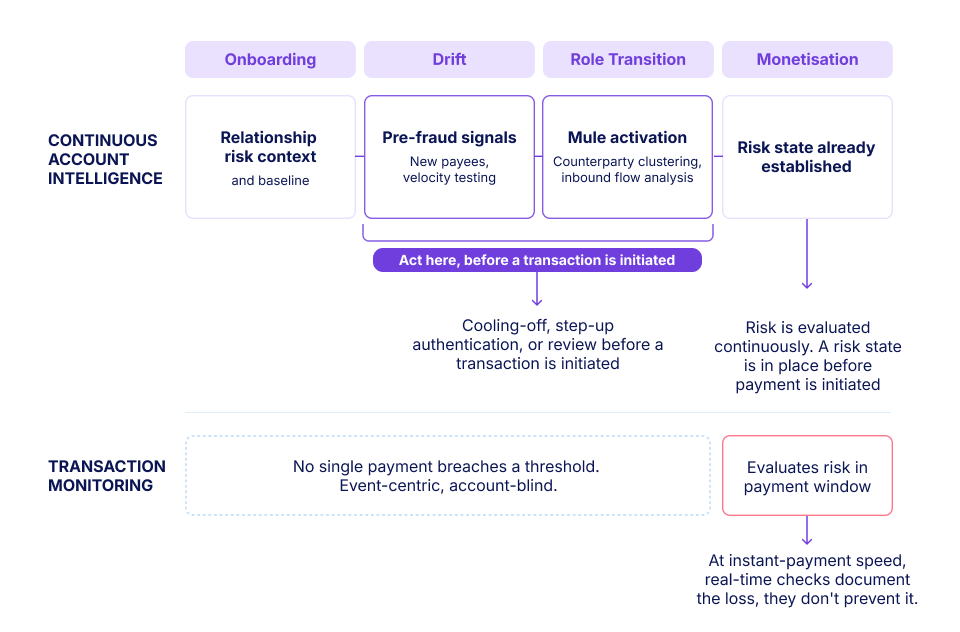
Persistent risk states enable proportionate controls. An account that has gradually accumulated risk indicators may warrant stepped-up authentication, delayed settlement, or a beneficiary cooling-off period. An account showing structural mule coordination warrants stronger intervention. Not blunt thresholds. Calibrated friction aligned with the trajectory.
Acoru’s AI Workforce runs continuously in the background, detecting emerging patterns across the account portfolio, raising alerts and recommending remediation. The Acoru AI Assistant sits alongside the analyst, answering questions in plain language and pulling relevant events into a single view. Every action ties back to observable account behavior, so model governance and examiner expectations hold under a risk-based standard.
Deployed as a Fraud Intelligence Hub on-prem or in a private cloud, Acoru reads existing feeds (transaction monitoring, online fraud detection, device intelligence, channel signals, enrichment sources) without replacing them. All customer data and all fraud decisions stay inside the bank.
For receiving banks facing Nacha Phase 2, PSR 50/50 and PS23/4, that is audit-defensible evidence grounded in observable account behavior, delivered before a transaction is initiated. Reduced scam losses. Reduced reimbursement exposure. Customer protection when it matters most.
It means assessing risk from onboarding through to a payment, using the whole sequence of account behaviour, rather than scoring only the transaction at the point money moves. The goal is to see risk building - and act on it - before the transfer.
Transaction monitoring answers whether a specific payment looks risky right now, which misses fraud where the customer authorises a payment that looks normal in isolation, such as APP scams and unwitting mule activity. The signal usually lives in the account's trajectory, not the single transaction.
Four: onboarding (positioning and baseline signals), account drift (gradual shifts in rhythm and counterparties), role transition (the account starts acting on someone else's instructions), and monetisation (large transfers and rapid dispersal, where traditional controls finally fire).
An approach that continuously classifies first-party and counterparty accounts by risk state (Regular, Victim, or Mule) by reading account events - logins, profile changes, new beneficiaries, transfers - as one connected sequence rather than isolated events.
Both push obligations onto the receiving side. Nacha Phase 2 (effective June 22, 2026) requires risk-based monitoring for entries including those authorised under "false pretenses," and the UK PSR's reimbursement regime (PS23/4) splits APP scam reimbursement 50/50 between sending and receiving PSPs. Account-level evidence is what supports compliance under both.
1 min read
In the banking industry, fraud often starts long before any payment is made, sometimes even weeks before any losses can be detected. For that reason,...
1 min read
Instant transfers, real-time payments, and mobile-first banking have created more opportunities for fraudsters to exploit urgency, impersonation, and...

1 min read
Money mule activity is often treated as a single category of risk. An account is flagged as a mule, controls are applied, and the case moves forward....