This solution
Holistic Fraud Prevention
If you are replacing legacy tools, consolidating or establishing a fraud stack baseline



Most institutions run multiple fraud tools, each bought to solve one problem. None connect to the others, and some institutions run no fraud solutions at all.
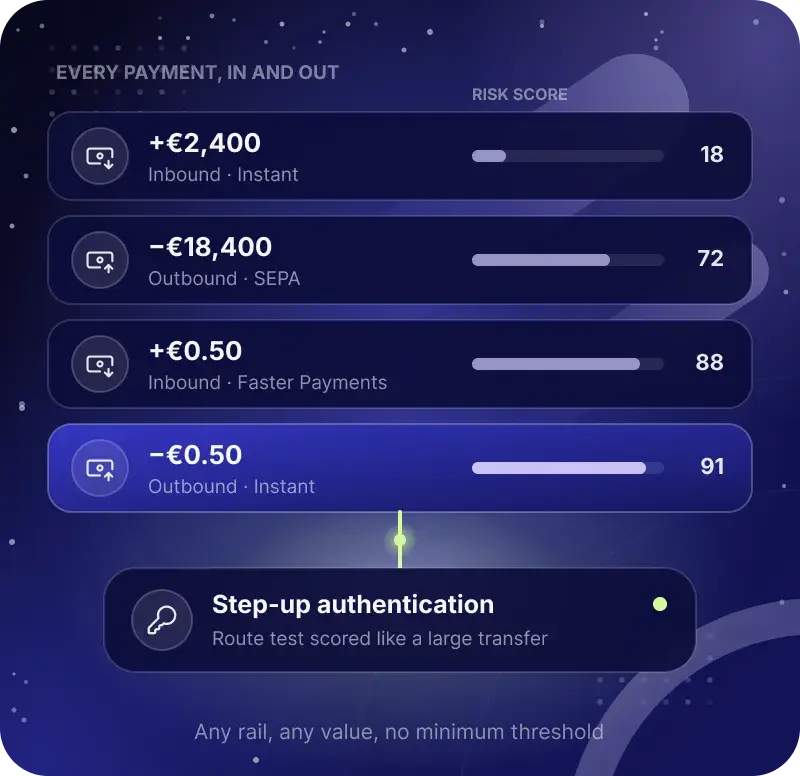
Datos Insights describes financial criminals' exploitation of AI as a critical inflection point: fraudsters can now automate and scale attacks that were previously impractical. Size no longer decides who gets attacked. They probe the gaps between tools, starting with test payments of a few cents to confirm a route.
You do not have to originate fraud to pay for it. Regulators are shifting liability to the receiving side, so a money mule account on your books is a cost you carry today.
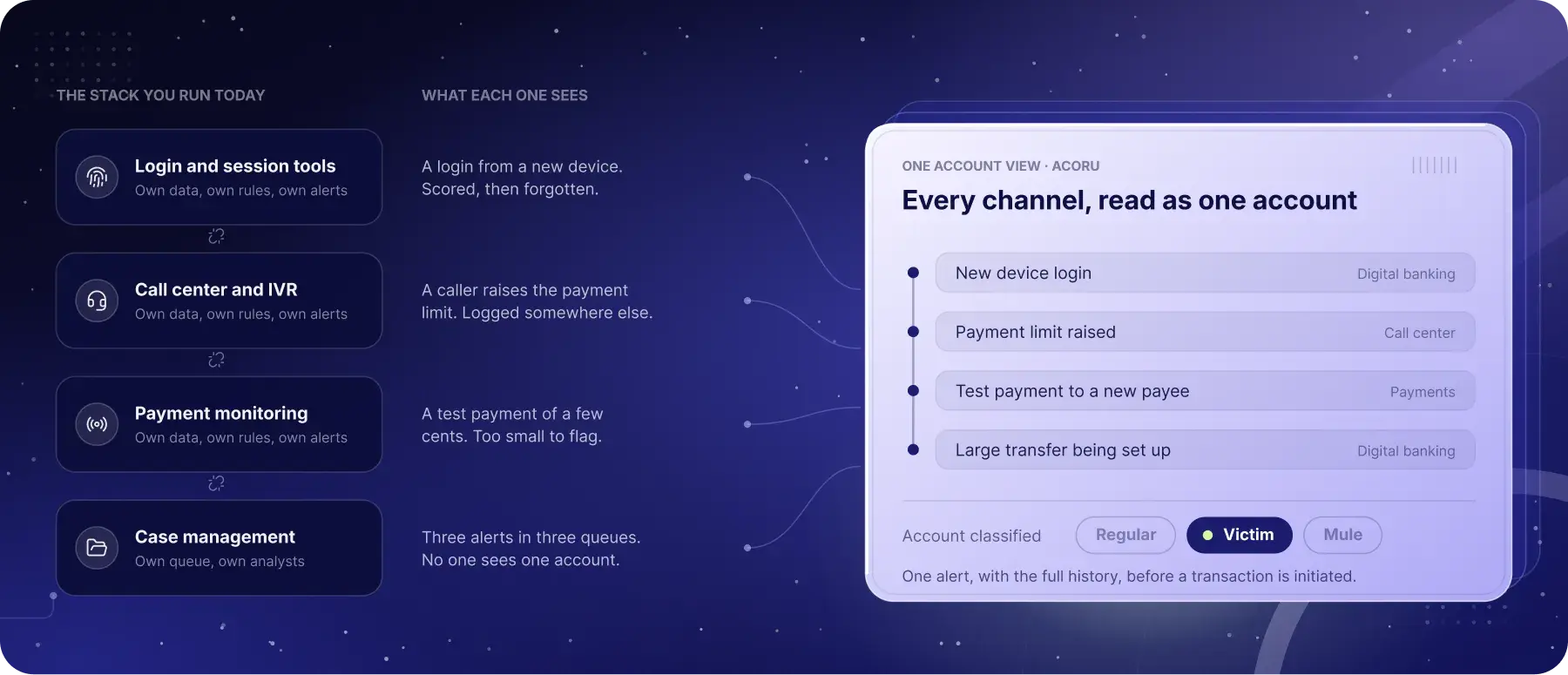
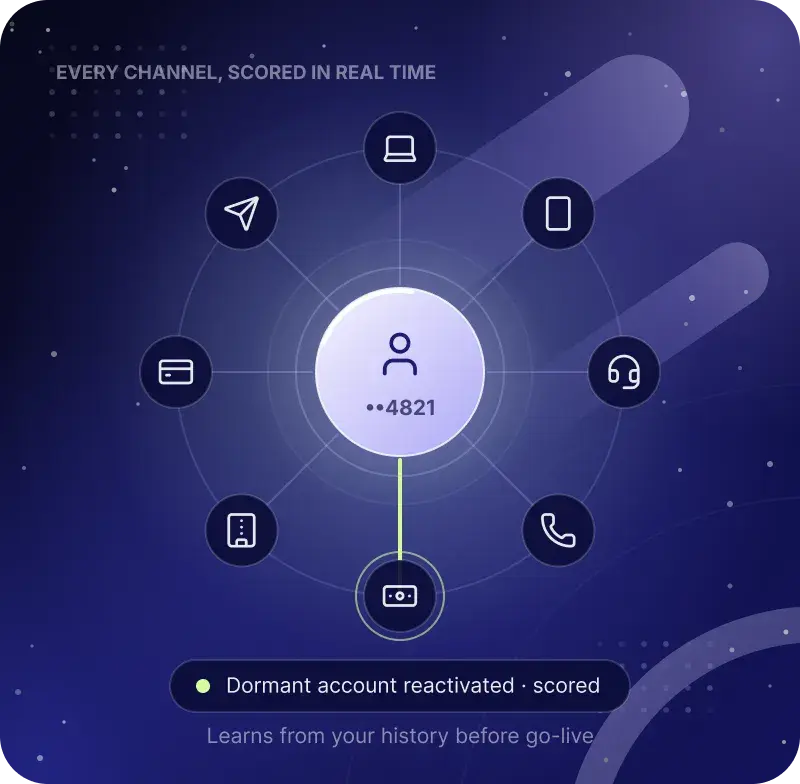
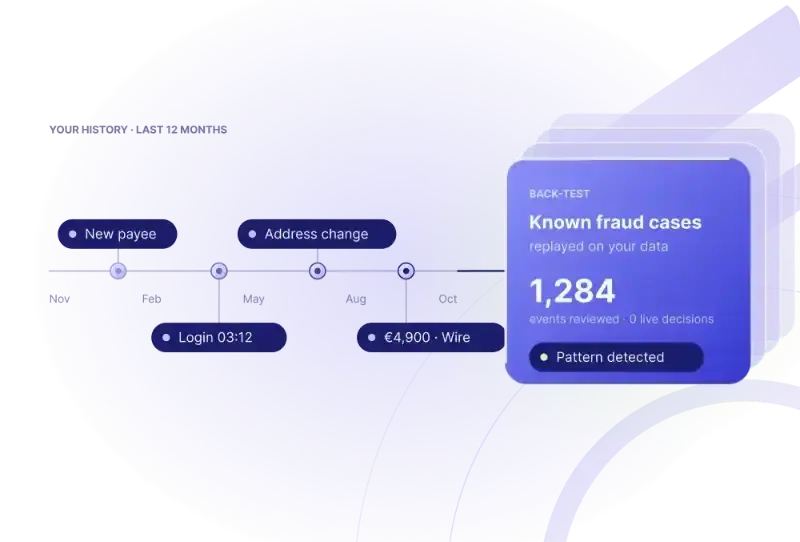
Every channel, event, session, and transaction is scored in real time. Across all channels you operate: digital banking, mobile, call center, IVR, ATM, branch, cards, and payments. It picks up account changes that often precede fraud, such as a dormant account reactivating. Acoru learns from your historical data before go-live, so classifications are useful from day one.
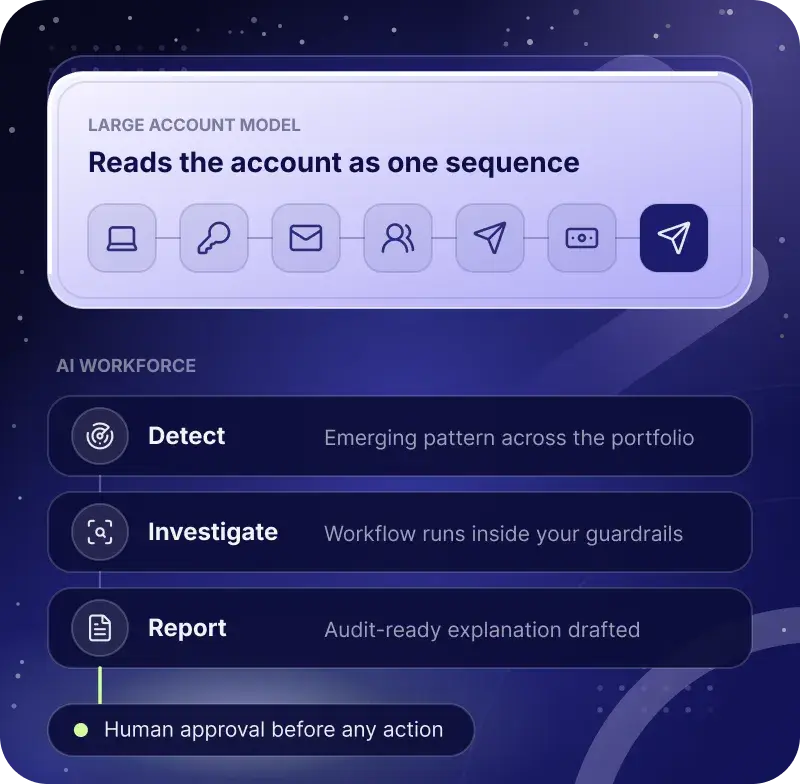
Your analysts spend their time on the decisions that need them. AI Workforce continuously monitors every account’s full behavioral history, surfaces emerging patterns, and runs investigation and mitigation workflows within the guardrails your institution sets.
AI Assistant explains every classification in plain language and drafts the report. Your policy decides what runs automatically and what waits for analyst approval, and every decision traces to observable account behavior.
Real-time fraud detection scores every payment, fast enough to stop instant payment fraud: inbound and outbound, across all rails, at any value, with no minimum threshold. A low-value test payment that validates a mule route is scored the same as a high-value transfer. When risk warrants it, Acoru orchestrates step-up authentication or other controls.
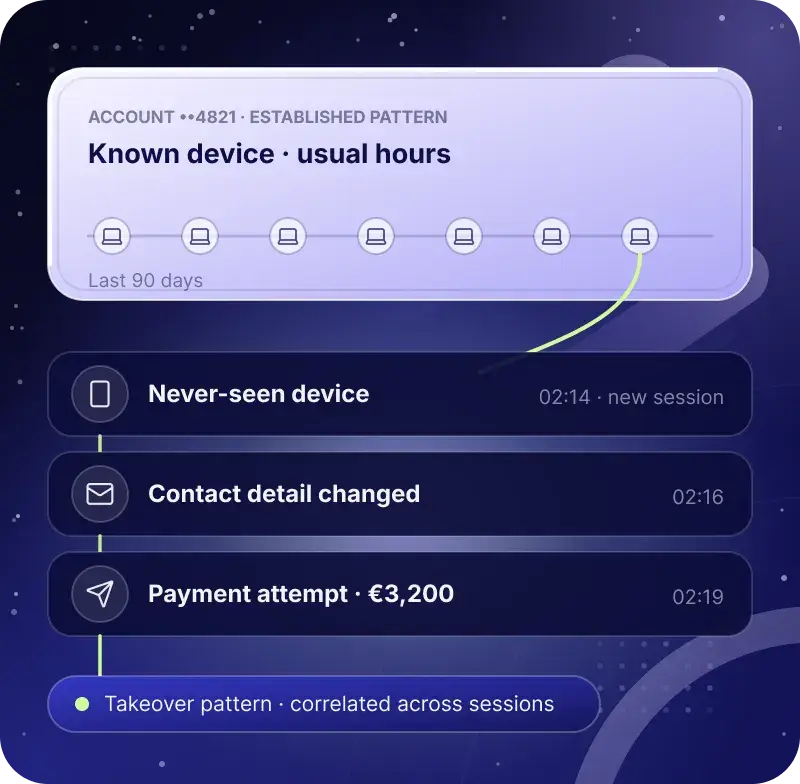
A takeover shows up as a break in an account’s established pattern: a never-before-seen device, an unfamiliar session, or a detail change followed quickly by a payment attempt. Acoru correlates device and session signals across sessions rather than judging each one in isolation.
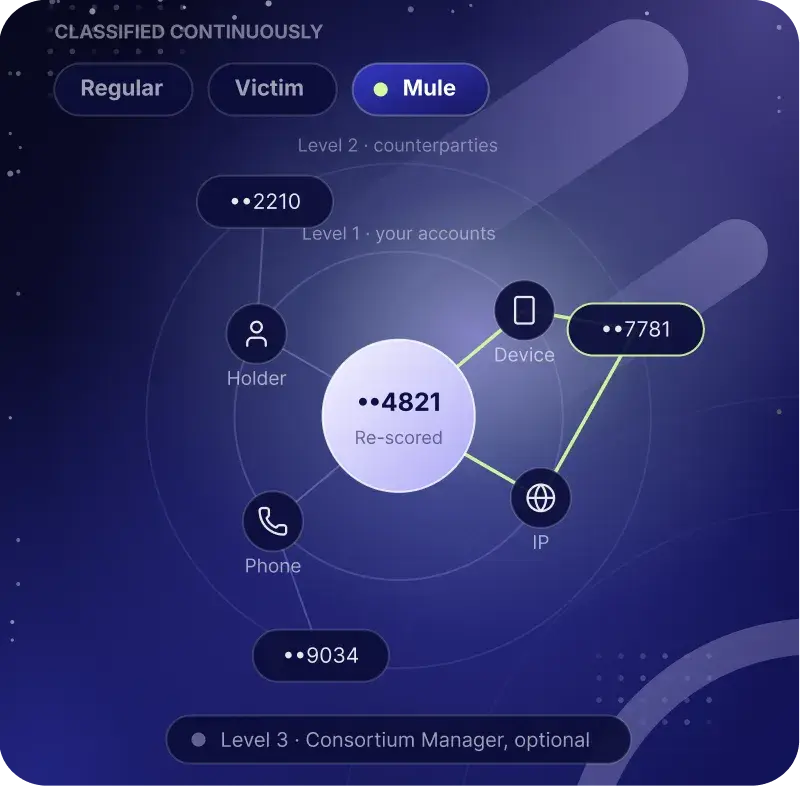
Acoru continuously classifies every account (Regular, Victim, or Mule) and scores the entities around it, for payers and payees alike, at Level 1 (accounts you hold) and Level 2 (their external counterparties), using your own data alone. Link analysis connects accounts that share a holder, device, IP, or phone, so a risk change re-scores every linked account. Consortium Manager adds Level 3 as an optional add-on.
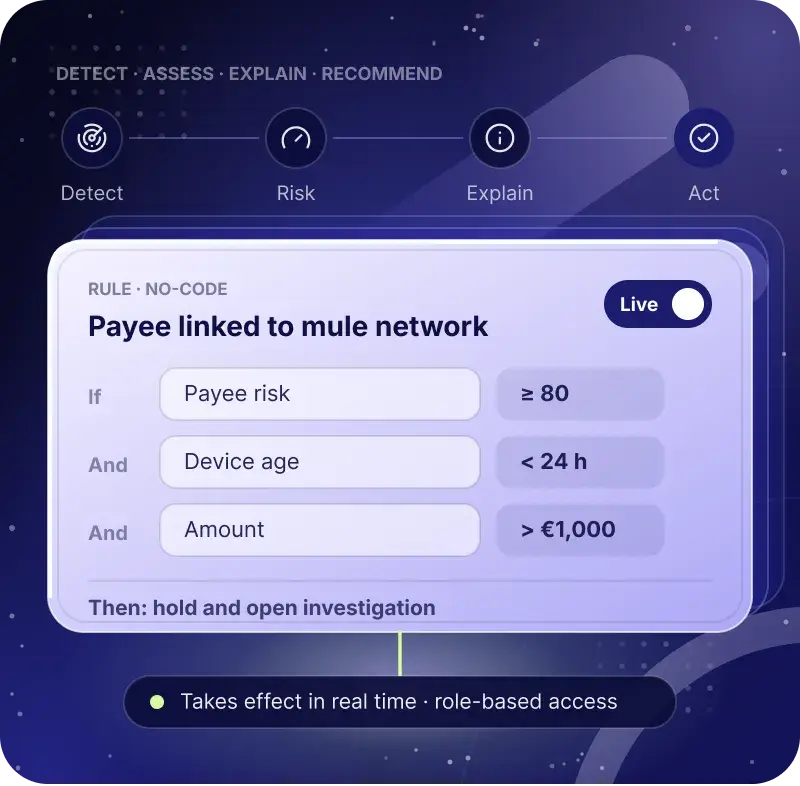
One console analyzes every event, so tuning happens in one place. The platform detects events, determines risk level, explains why, and recommends an action. Analysts open an investigation from any account, alert, or query and expand through related entities with graph tools. Rules and thresholds change in a no-code interface and take effect in real time, under role-based access controls. Detection runs on Acoru's standard library of attributes, signals, and rules.
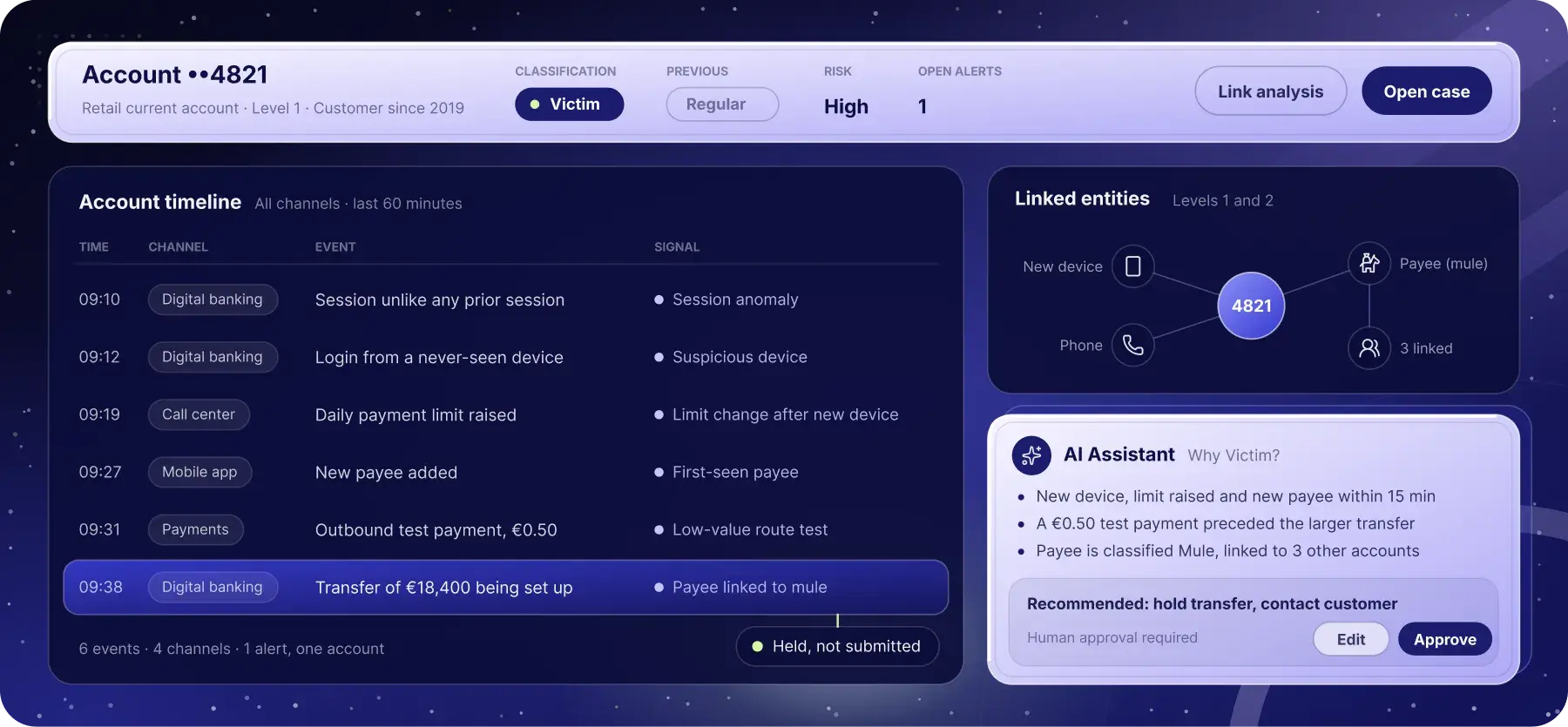
Most institutions buy transaction monitoring and online fraud detection solutions separately. That means multiple contracts, multiple integrations, multiple rule sets, and two teams tuning thresholds. It also means no link between the login session and the payment that follows it. Holistic Fraud Prevention covers both on one platform:

Connect your channels and data sources once. Every event lands in one model of the account.
Build a signal once and use it across payments, sessions, and onboarding, instead of maintaining the same logic in two systems.

Analysts work one alert per account, with the session, device, and payment history in one view, not one alert per system.

One vendor to procure, deploy, govern, and audit.
The savings are not only in licenses. They're in the integration projects you don't run, the independent rule sets you don't maintain, and the investigations your team doesn't repeat across tools.

using victim classification.

to limit receiving-side liability.

with real-time inbound and outbound scoring across rails.

by spotting links to known fraud or mule activity before the account can collect scam proceeds or run up losses.

by reading sessions, devices, and payments against the account's own history.
New regulation and payment-scheme rule books are moving fraud accountability earlier, to before a transaction is initiated. They are also spreading it across sending and receiving banks.


Since 7 October 2024, the Payment Systems Regulator's reimbursement requirement has obliged payment service providers to refund victims of authorised push payment (APP) scams on Faster Payments and CHAPS, up to £85,000 per claim, unless the customer acted with gross negligence. The sending and the receiving Payment Service Provider (PSP) split the cost 50:50. Confirmation of Payee checks the name on the account; it cannot tell you the account is a mule.
“Now that both parties in the payment journey (the sending PSP and the receiving PSP) share the cost of reimbursing victims, there is a much stronger incentive for all PSPs to prevent APP scams from occurring in the first place.”

Since 9 October 2025, the Instant Payments Regulation (IPR) has required Verification of Payee (VoP) on euro credit transfers. A money mule account opened in the right name passes cleanly. Once they apply, the EU Payment Services Regulation and PSD3 will require fraud monitoring, fraud-data sharing, and refunds for consumers deceived by bank impersonators. The mule account is becoming the receiving bank’s problem.
“Mandatory fraud preventive measures will be applied and lead to less payment fraud. Banks have to share more of the burden if they fail to do their part.”

Nacha’s Operating Rules are private-sector rules that bind every Automated Clearing House (ACH) participant by contract. The largest participants have been covered since March 20, 2026, and all others since June 19, 2026. The rules require risk-based monitoring of ACH credits initiated due to fraud, including those made under false pretenses. For a receiving bank, that means watching the credits that land in its customers’ accounts.
“These rules require fraud monitoring by Originators, Third-Party Service Providers, Third-Party Senders and ODFIs to identify ACH credit entries initiated due to fraud, including transactions authorized under false pretenses.”
This solution
If you are replacing legacy tools, consolidating or establishing a fraud stack baseline

When scams or money mules are your biggest challenge, add decisions span the full account lifecycle, with mule and victim subtypes and orchestration built in.
Explore solution: Scam Prediction and Mule Classification

Share fraud intelligence with other institutions and see risk beyond the accounts you hold.
Explore solution: Consortium Manager
Selected for our account-centric approach, which identifies risk before payment and supports both fraud and AML decisioning.
Download Datos report