Holistic Fraud Prevention
If you are replacing legacy tools, consolidating or establishing a fraud stack baseline
Explore solution: Holistic Fraud Prevention



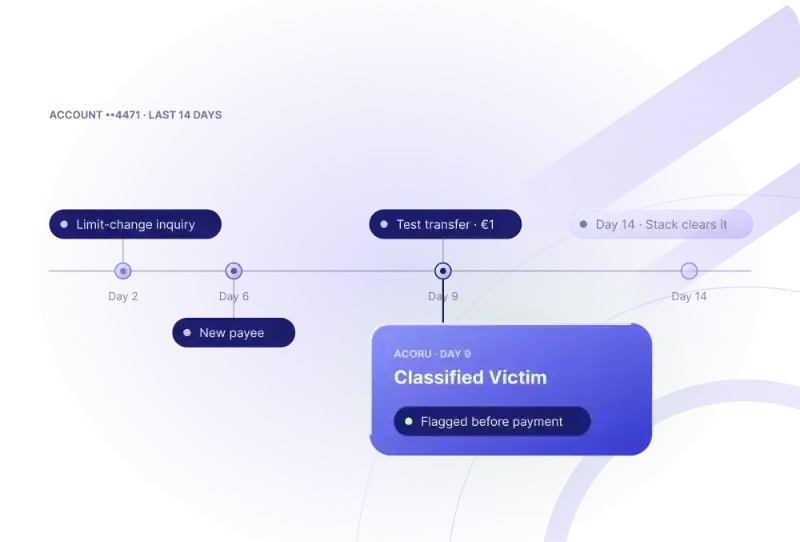
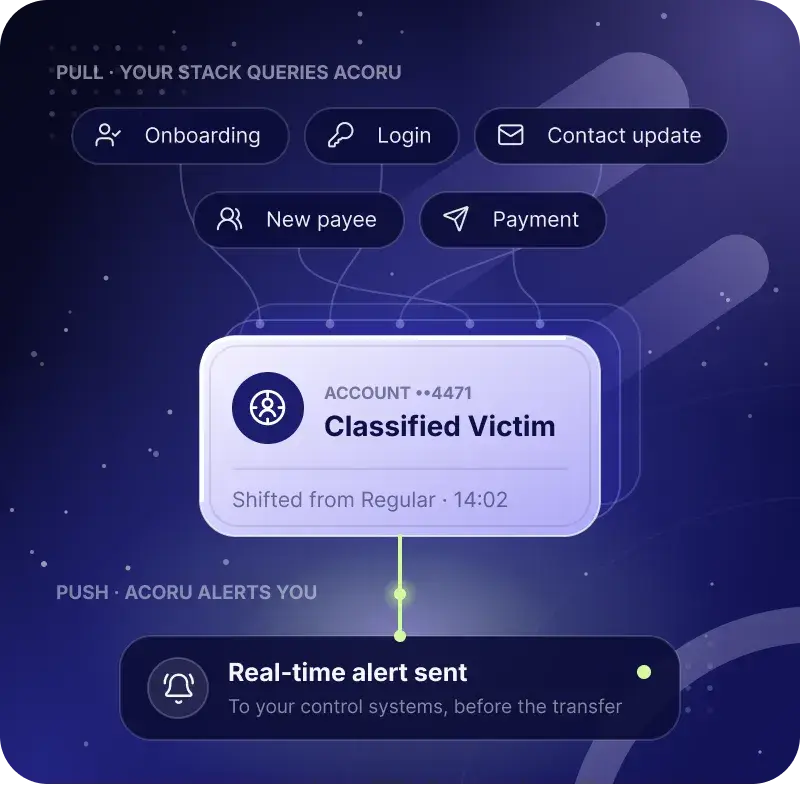
It reads every event around a customer's account and the entities behind it. As those signals line up into a pattern, the classification shifts from Regular to Victim before the payment screen. An event, not a transaction, moves the score, and the change cascades: it re-scores that account and every account linked to it, across the accounts you hold (Level 1) and their external counterparties (Level 2).
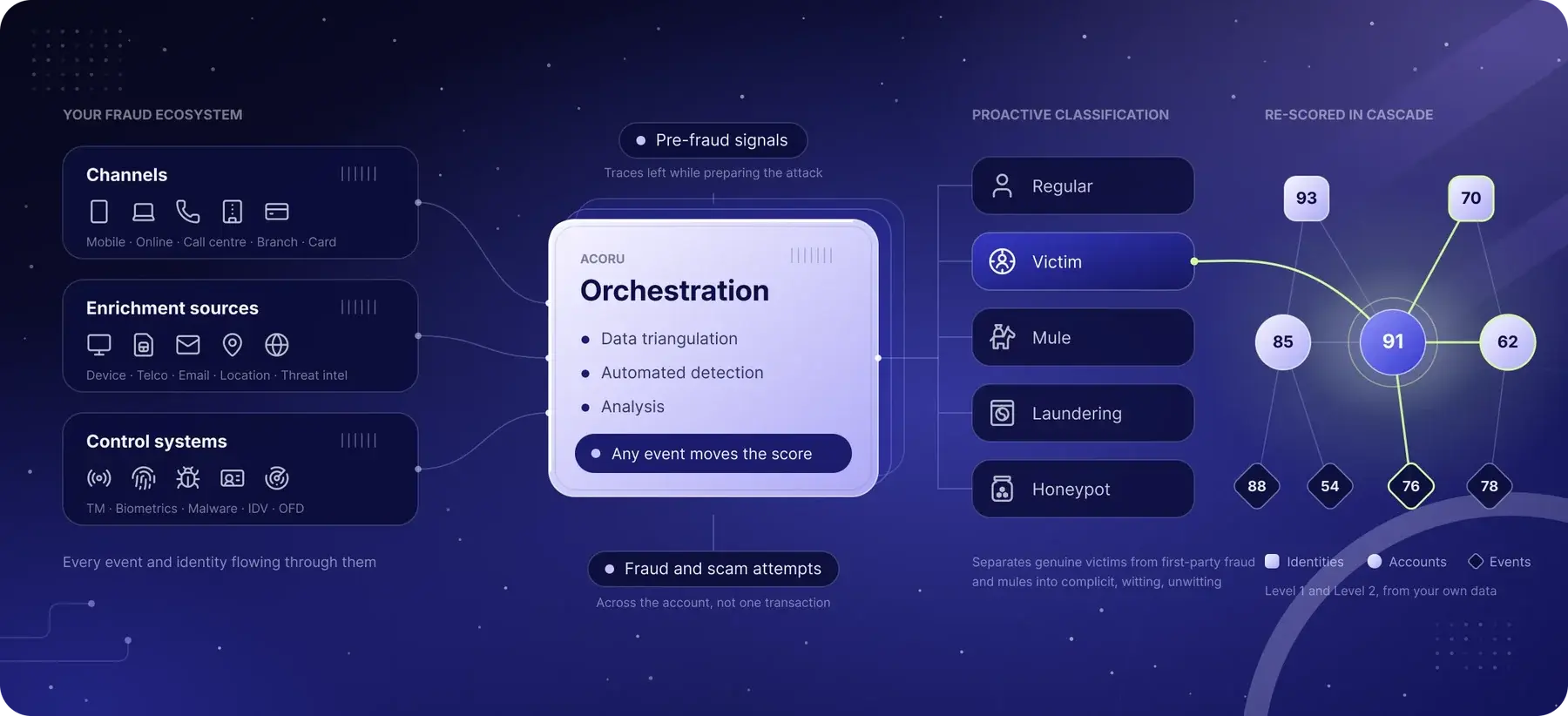
Victims and mules are two halves of one crime. Stopping it means understanding their relationship before a transaction is initiated.
In APP fraud, victims send the money themselves. The warning signs sit across the account’s lifecycle: a limit-change inquiry, a new payee, a test transfer. On the receiving end, mule accounts move the proceeds within minutes.
Traditional fraud stacks only see the last several seconds before a payment. In that window, everything checks out: the customer authorizes the transfer, authentication passes, and the device is recognized. By the time transaction monitoring spots a pattern, the money is gone.
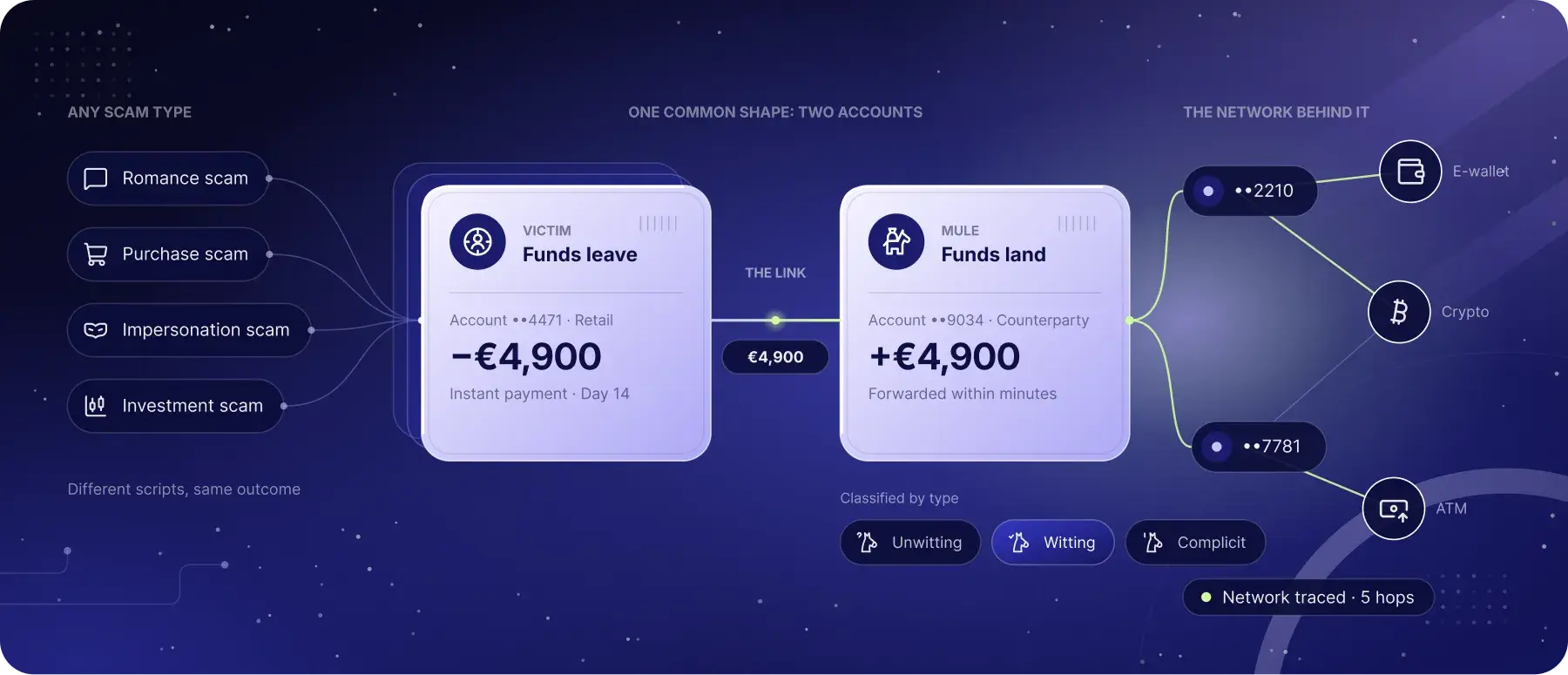
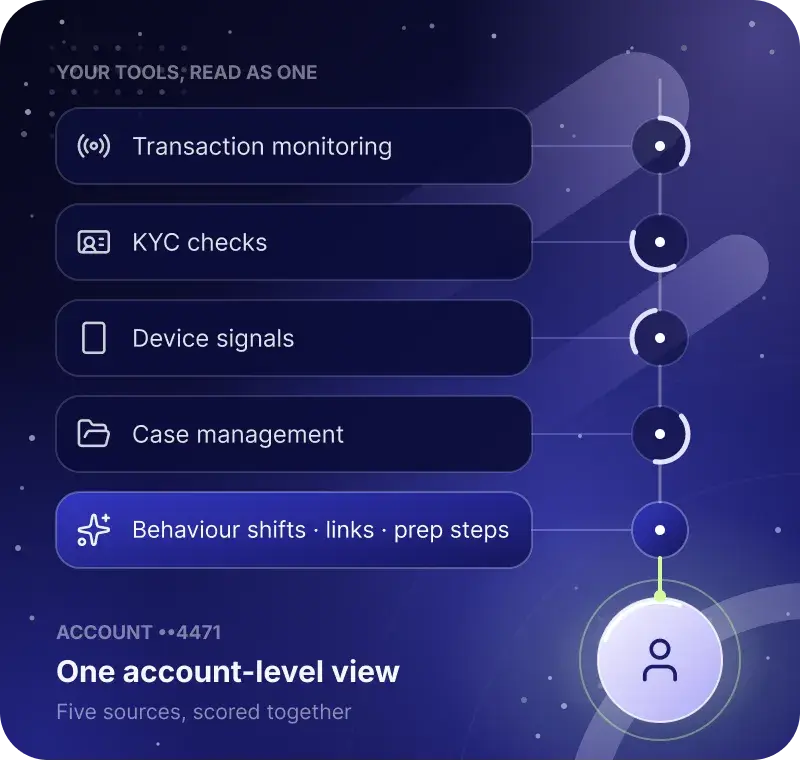
Point solutions evaluate individual events and rarely share context. Acoru turns their signals into account-level risk and adds its own: behavioral drift, counterparty and mule-network links, and preparation steps. That includes mule testing, new payees, and raised limits before the cash-out. You keep your stack and see the scam forming, the victim being turned, and the mule waiting.
Acoru continuously classifies every account as Regular, Victim, Mule, or Laundering, and separates mule accounts into complicit, witting, and unwitting. It also separates genuine victims from first-party fraud. Laundering accounts move or mix illicit funds. Honeypot accounts are deliberately exposed to gather intelligence on attackers. By the time a customer reaches the payment screen, the risk context is already in place. Low-friction controls fire automatically, and the calls that need a human reach your analysts already backed by evidence.
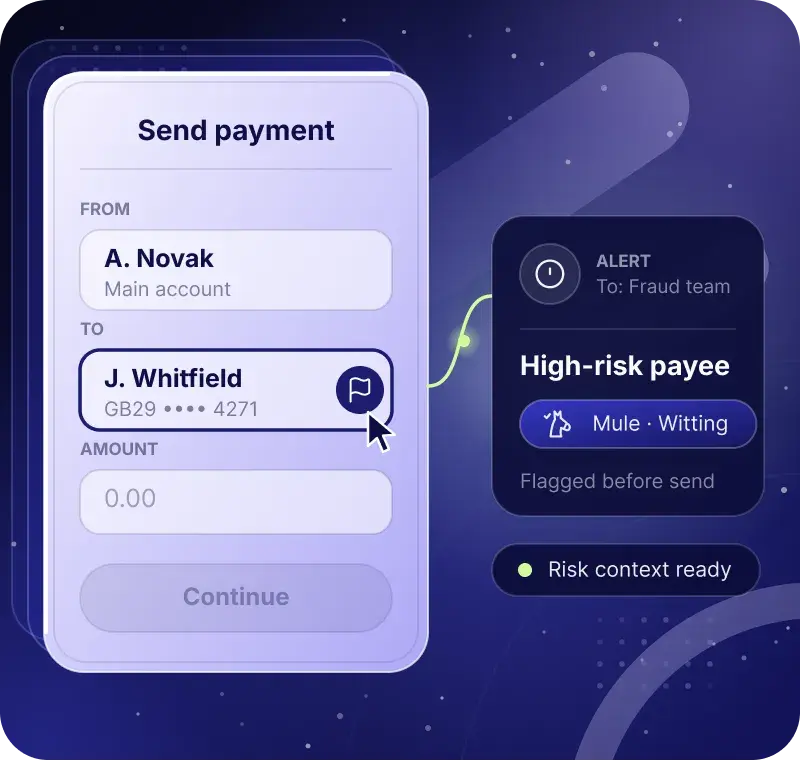
Your existing stack queries Acoru across key moments: onboarding, authentication, contact updates, payee creation, product requests, and payment execution.
Acoru also pushes continuously: when an account classification shifts, real-time alerts flow directly to your control systems, so you can intervene before the customer initiates a transfer. That is scam detection and prevention before a transaction is initiated.
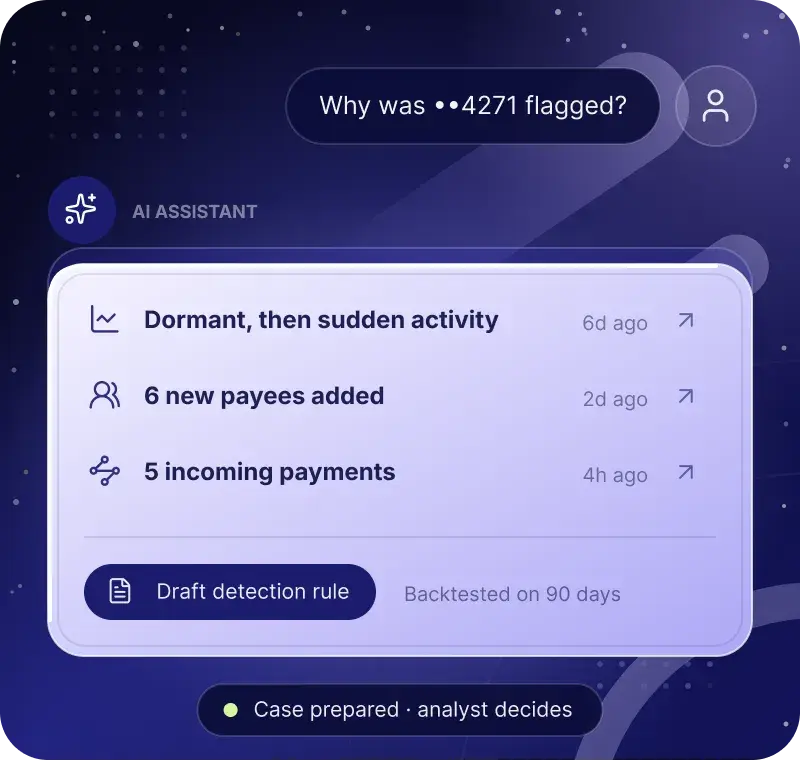
Everyone promises fewer false positives. Acoru changes the analyst’s day. Answers no longer wait on a data team: ask in natural language, and the platform builds the dashboard, explains why an account was flagged with links to the evidence, and drafts detection rules with simulation and backtesting. The platform prepares the case. Your analysts make the call.
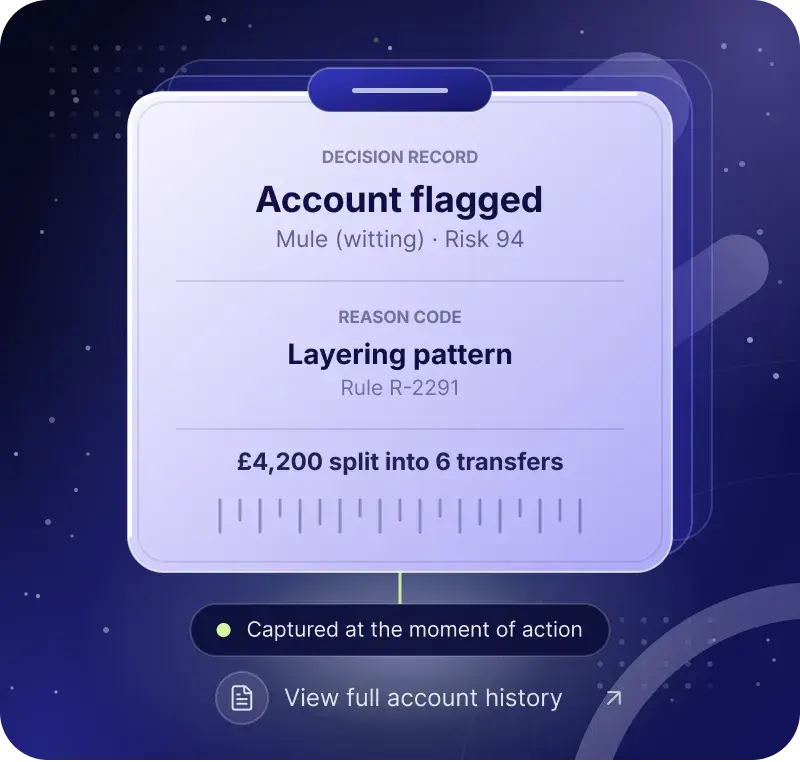
Every intervention carries reason codes and decision logic, captured at the moment of action. The record exists before anyone asks for it. A held payment is defensible, and every decision is documented for governance and ready for internal and supervisory oversight.

Scams leave traces long before the payment: a coached contact change, an unusual login, a device tied to a mule network. Transaction monitoring sees none of it. Acoru flags victim accounts while the scam is being staged, so your team intervenes before a transaction is initiated.

Scams cross channels: a fake bank call, a new-device login, a new payee, an instant transfer. Each control sees only its own piece. Acoru resolves activity from every channel to one account, so the risk shows at payee setup, before a transaction is initiated.

Every account and counterparty carries a live classification (Regular, Victim, or Mule), updated at onboarding, login, payee setup, and payment. Mules are separated into complicit, witting, and unwitting, because each calls for a different response. Mule-linked destinations at other banks surface from your own data.

Acoru reads each account’s lifecycle as one sequence, so small changes form a scam narrative. AI Workforce runs investigation workflows inside your guardrails. AI Assistant explains every flag in plain language, links the evidence, and drafts new detection rules. An analyst approves each one before it goes live.
Selected for our account-centric approach, which identifies risk before payment and supports both fraud and AML decisioning.
Download Datos report
Classify payer and payee risk before the customer authorizes the payment.

Victim classification triggers a dynamic warning that breaks the scam’s spell.

Identify an applicant’s mule-network exposure from your own data at onboarding

Add pre-transaction risk context to sharpen your transaction monitoring.

Surface loan-scam victims before disbursement so losses stay off the book.

Name checks confirm the payee. Acoru flags mule-linked destinations at setup.
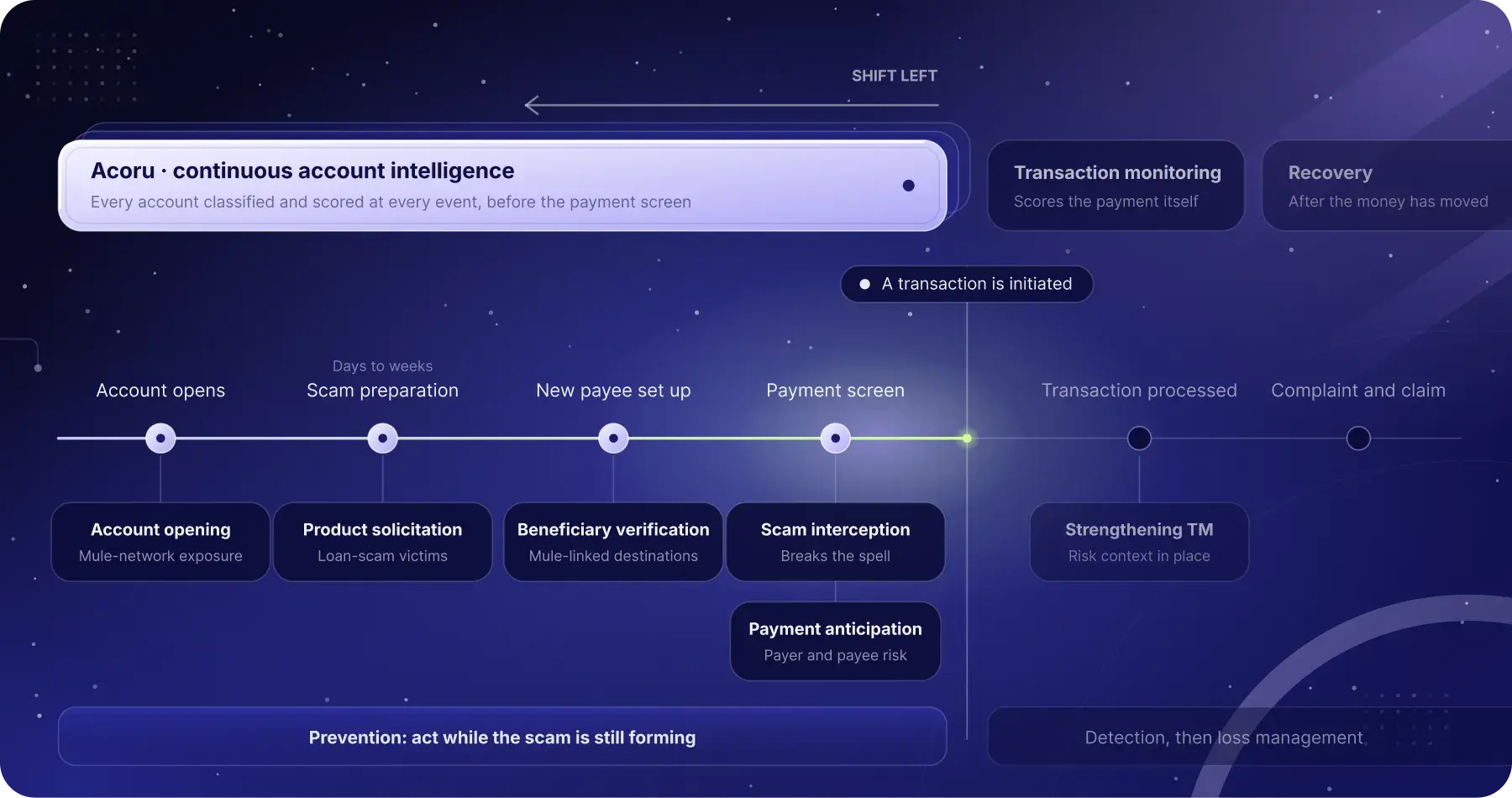
New regulation and payment-scheme rule books are moving fraud accountability earlier, to before a transaction is initiated. They are also spreading it across sending and receiving banks.


Since 7 October 2024, the Payment Systems Regulator's reimbursement requirement has obliged payment service providers to refund victims of authorised push payment (APP) scams on Faster Payments and CHAPS, up to £85,000 per claim, unless the customer acted with gross negligence. The sending and the receiving Payment Service Provider (PSP) split the cost 50:50. Confirmation of Payee checks the name on the account; it cannot tell you the account is a mule.
“Now that both parties in the payment journey (the sending PSP and the receiving PSP) share the cost of reimbursing victims, there is a much stronger incentive for all PSPs to prevent APP scams from occurring in the first place.”

Since 9 October 2025, the Instant Payments Regulation (IPR) has required Verification of Payee (VoP) on euro credit transfers. A money mule account opened in the right name passes cleanly. Once they apply, the EU Payment Services Regulation and PSD3 will require fraud monitoring, fraud-data sharing, and refunds for consumers deceived by bank impersonators. The mule account is becoming the receiving bank’s problem.
“Mandatory fraud preventive measures will be applied and lead to less payment fraud. Banks have to share more of the burden if they fail to do their part.”

Nacha’s Operating Rules are private-sector rules that bind every Automated Clearing House (ACH) participant by contract. The largest participants have been covered since March 20, 2026, and all others since June 19, 2026. The rules require risk-based monitoring of ACH credits initiated due to fraud, including those made under false pretenses. For a receiving bank, that means watching the credits that land in its customers’ accounts.
“These rules require fraud monitoring by Originators, Third-Party Service Providers, Third-Party Senders and ODFIs to identify ACH credit entries initiated due to fraud, including transactions authorized under false pretenses.”
If you are replacing legacy tools, consolidating or establishing a fraud stack baseline
Explore solution: Holistic Fraud Prevention
This solution
When scams or money mules are your biggest challenge, add decisions span the full account lifecycle, with mule and victim subtypes and orchestration built in.

Share fraud intelligence with other institutions and see risk beyond the accounts you hold.
Explore solution: Consortium Manager
See where Acoru would have caught it.