<img height="1" width="1" style="display:none;" alt="" src="https://px.ads.linkedin.com/collect/?pid=8776498&amp;fmt=gif"> Skip to content

Acoru Platform

Continuous Account Intelligence Platform

The platform behind scam prediction, mule classification, and fraud prevention.

Acoru continuously classifies every identity, account, and associated event, so risk context is already in place before a transaction is initiated.

  • Online banking
  • Mobile
  • IVR
  • Call center
  • ATM
  • Branch
  • P2P
  • CNP · POS
  • Onboarding & KYC
  • Online fraud detection
  • AML monitoring
  • Device intelligence
  • Network intelligence
  • Threat intelligence

One account view

Platform architecture

One platform, deployed inside your own infrastructure.

Acoru unifies data from every source, classifies account risk, decides the response, and shows analysts the evidence behind each alert. Scores, alerts, and reason codes return to the systems you already run.

Omnichannel Orchestrator

Every source, unified into one account view.

  1. 01Entity Map
  2. 02Ingest any source
  3. 03Flows
  4. 04New entities in minutes
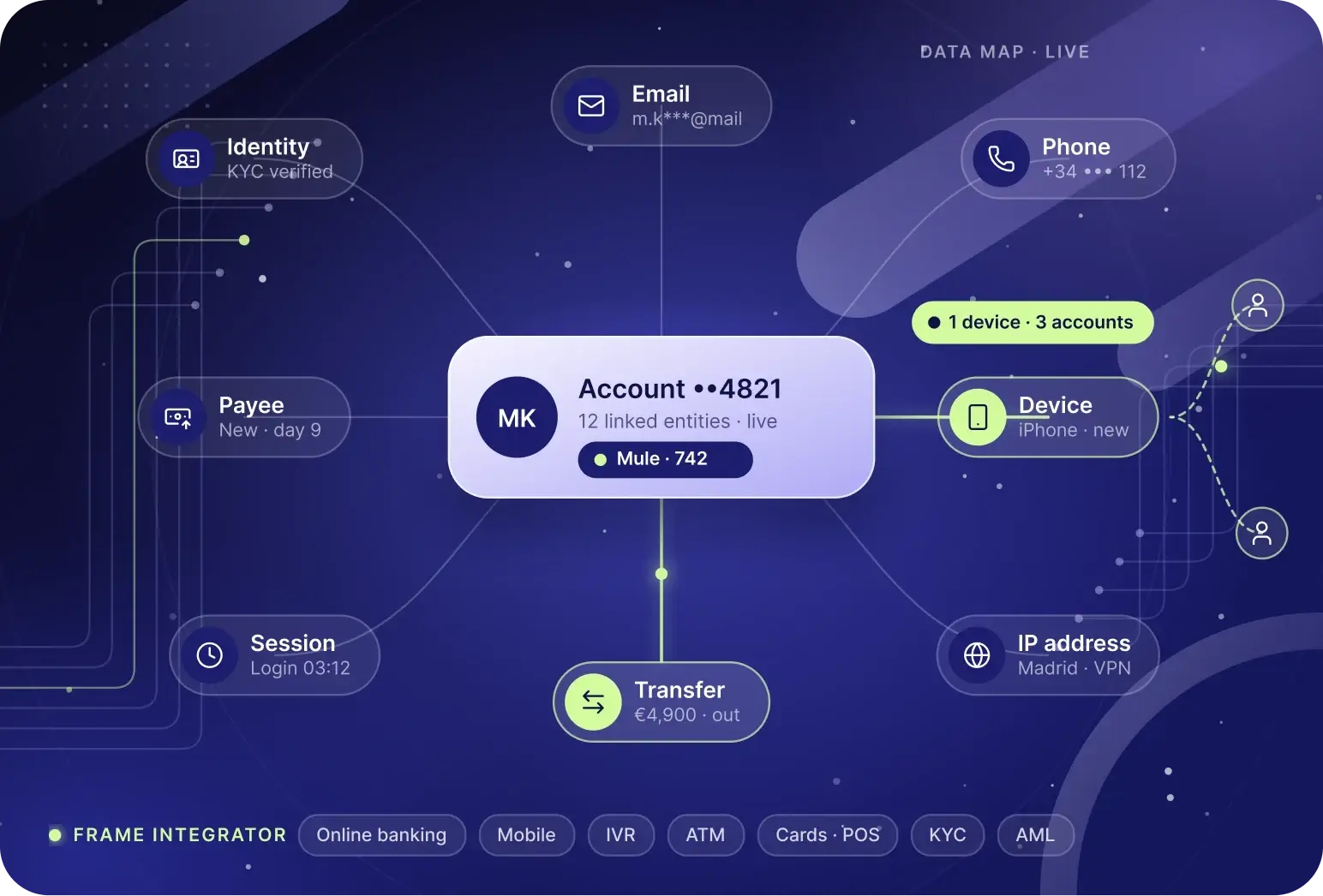
Entity map: an account connected to its identity, payees, sessions, devices, phone, email, IP address and transfers.

Entity Map

Your whole intelligence, at a glance.

Every entity on one canvas. Accounts, identities, customer identification numbers, movements, sessions, devices, phones, emails, and the relationships between them, drawn automatically as a connected graph. No more guessing which version of the data is in use. One picture, complete and always current, that anyone on the team can read. The Frame Orchestrator builds and maintains it.

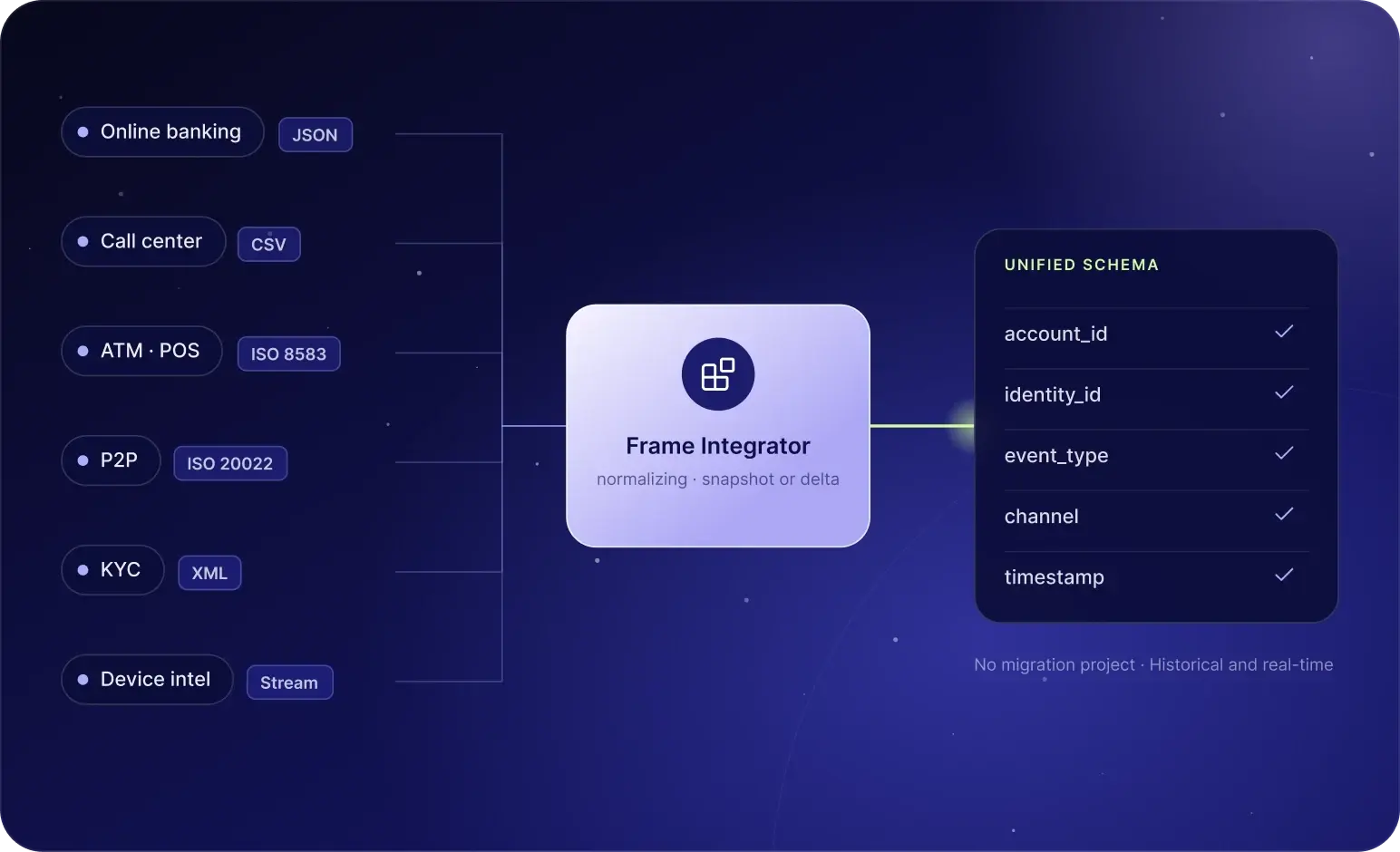
Frame Integrator normalizing events from online banking, call center, ATM, P2P, KYC and device intelligence.

Frame Integrator

Ingest any source, normalized on the fly.

This is fraud orchestration at the data layer: connect a new source in any format or schema, and the platform normalizes it on ingestion. No migration project. No waiting on engineering. Whether your source sends a full snapshot or just what changed, the data lands clean and ready to use. Coverage spans online banking, mobile, IVR, call center, ATM, branch, P2P, CNP, and POS, alongside onboarding and KYC, online fraud detection, AML monitoring, and device, network, and threat intelligence. Historical and real-time, structured and unstructured.

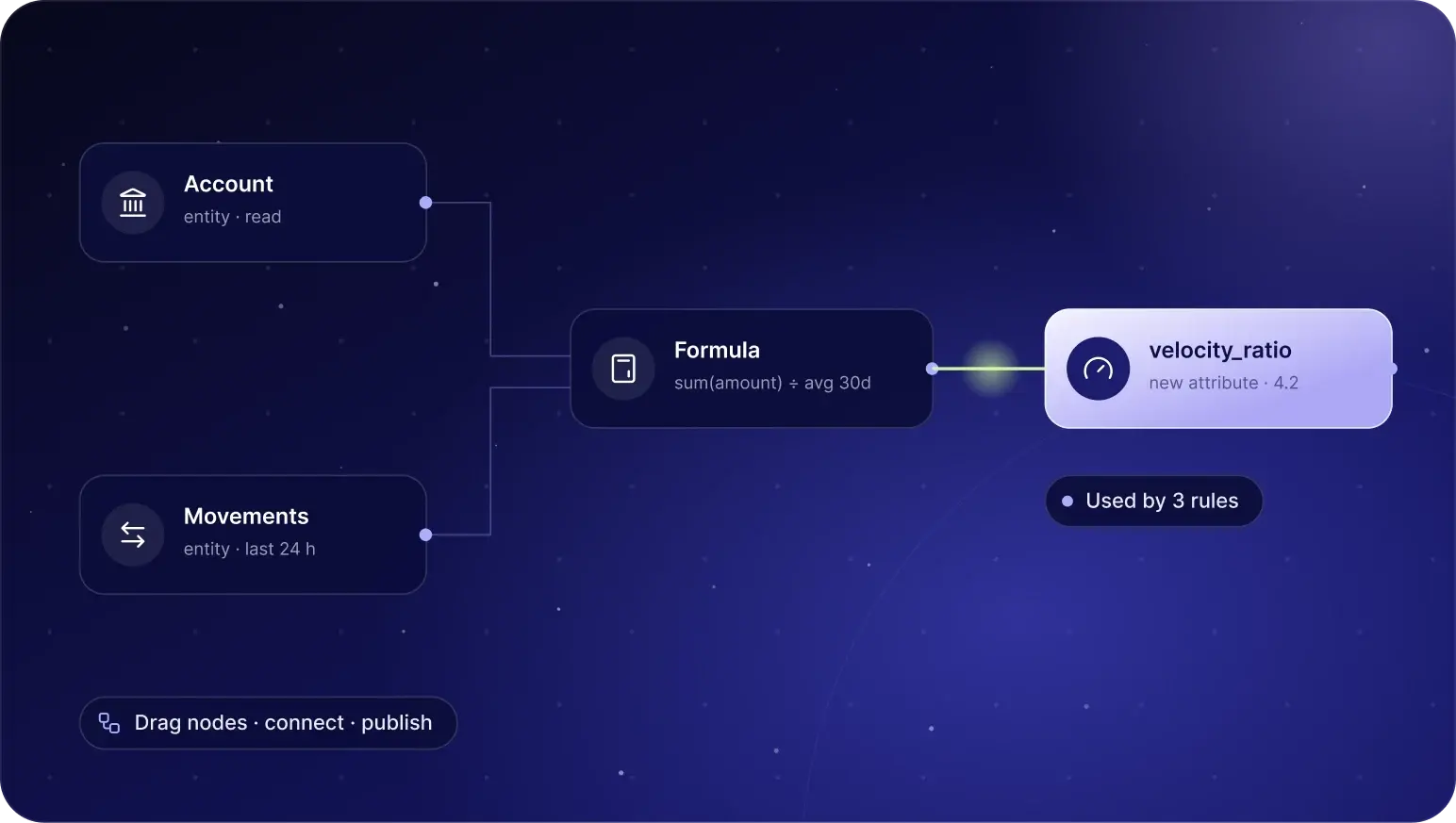
Flows canvas: account and movement nodes feeding a formula that outputs a velocity ratio.

Flows

Build custom attributes, formulas, and metrics without code.

The signals that matter rarely live in one place. Flows let you read from any entity and build new attributes, apply formulas, and compute the metrics your rules depend on by connecting nodes on a canvas. The logic that catches today's scam is yours to build, and yours to change.

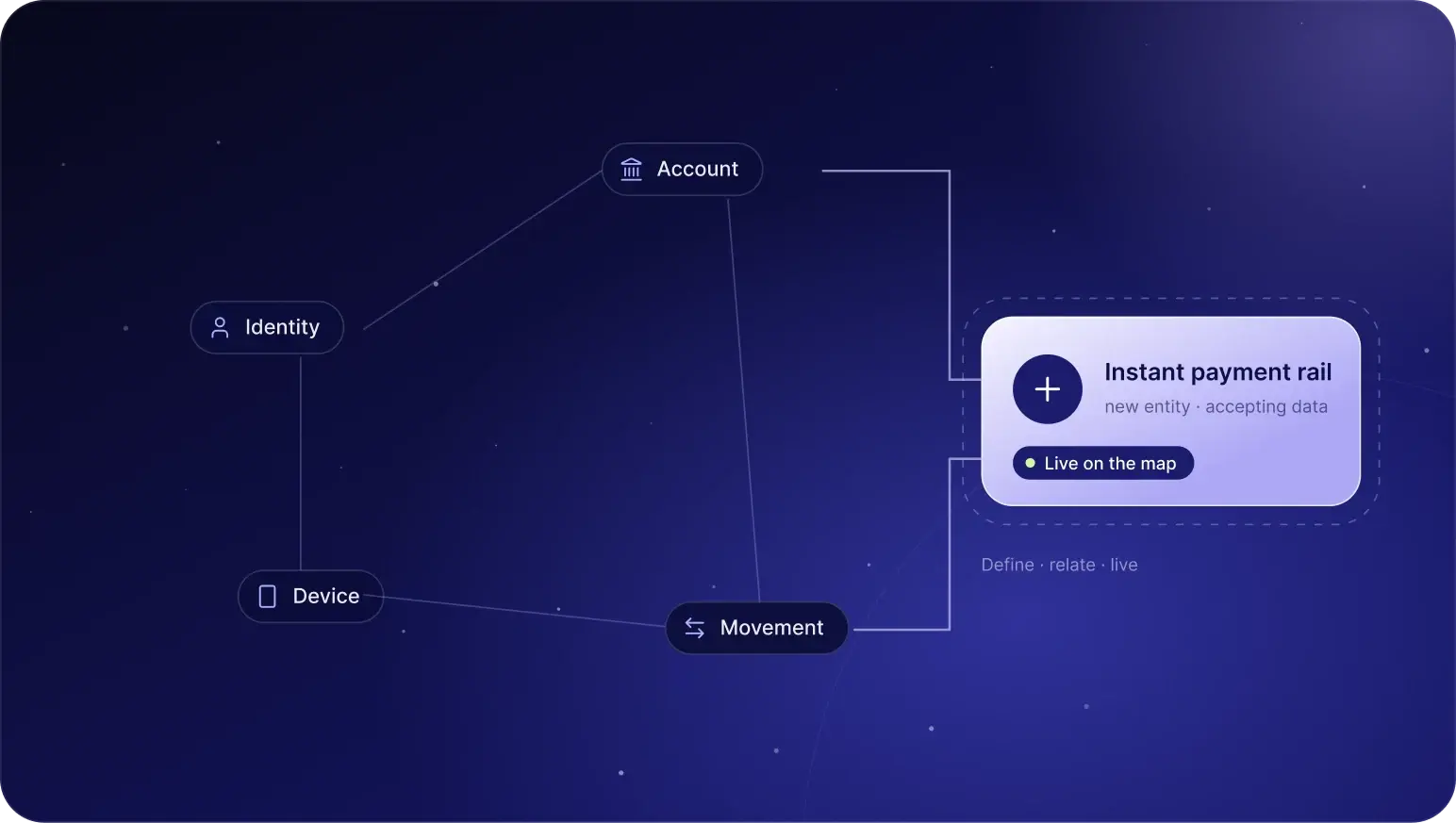
A new Instant payment rail entity added to the map next to identity, account, device and movement.

New entities in minutes

A data architecture that evolves as fast as fraud.

A new market, a new payment rail, or a new attack pattern only needs a new entity. Define it, relate it to the rest, and it is live, accepting data and visible on the map immediately. No multi-component rebuilds. No long timelines. Detection logic adapts as tactics change because the underlying architecture was designed to extend.

Account Intelligence

Scams leave a trail before
the transaction.

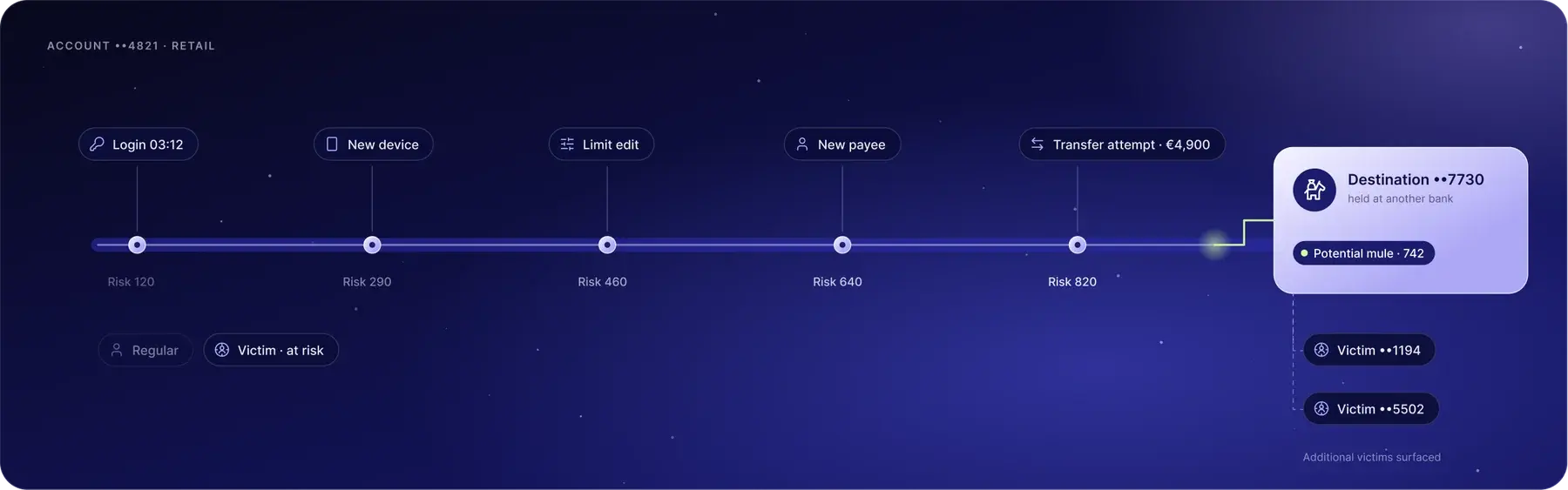
Acoru monitors accounts and all their associated events, not just transactions: logins, sessions, device changes, profile and limit edits, payee additions, transfer attempts, contact center interactions. These events update the account's risk state and cascade to linked accounts and entities. When signals appear in sequence, Acoru flags the destination as a potential mule and surfaces additional victims.

Account timeline: login, new device, limit edit, new payee and a transfer attempt raise the risk score until the destination is flagged as a potential mule and other victims surface.

Five account states, updated continuously.

Hover a state to reveal how Acoru separates it.

Mule

Moves money between victims and criminals. Acoru separates three types of mule accounts.

  • Complicit Opened for criminal activity from the start.
  • Witting The holder knowingly lends the account for a cut.
  • Unwitting The holder is being used and does not know it.

The distinction matters. An unwitting mule is often a scam victim too, and needs a different response than a complicit account.

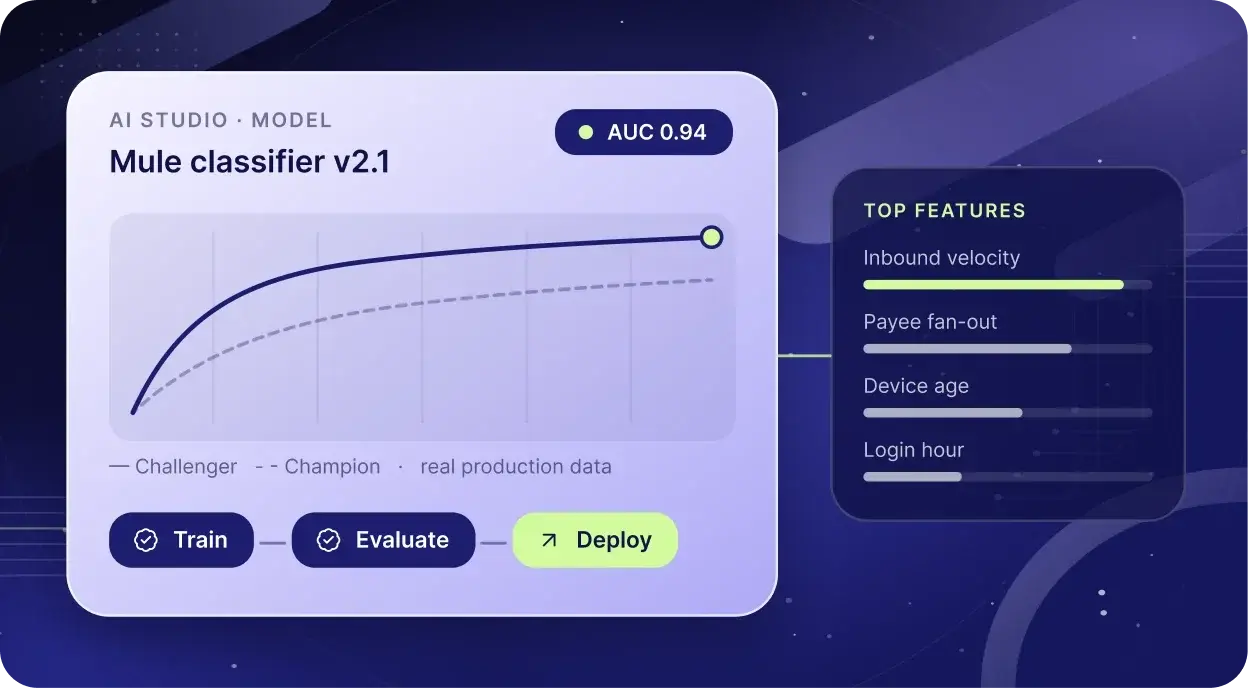
Each account carries a risk score from 0 to 1000.

Higher means greater risk, plus a score per classification type. Your systems receive scores in two ways: they query them on demand, or Acoru pushes scores and alerts to your channels.

  • 0–1000

    Risk score per account

    Plus a score per classification type.

  • <100 ms

    Query on demand

    Typical response times, including instant payment and Strong Customer Authentication (SCA) flows.

  • Push

    Scores and alerts to your channels

    The bank steps in with the customer in real time, before a transaction is initiated.

Detection Management

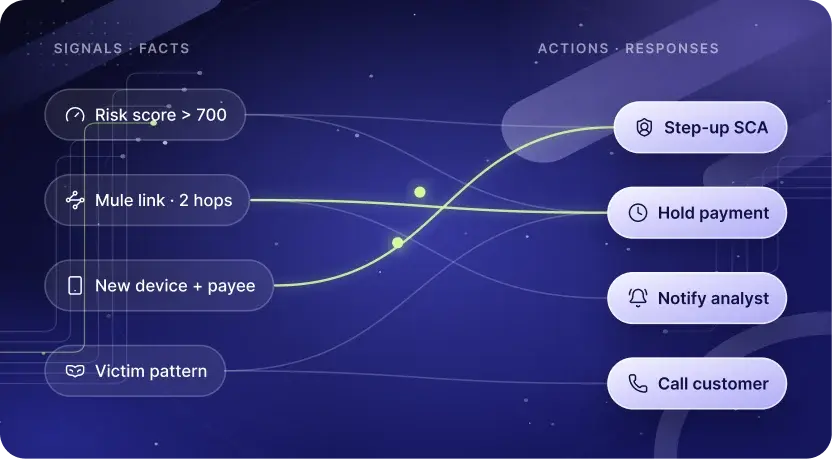
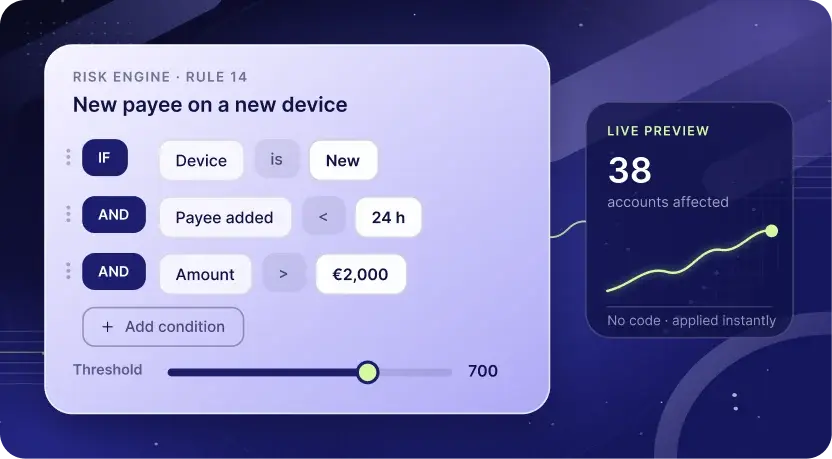
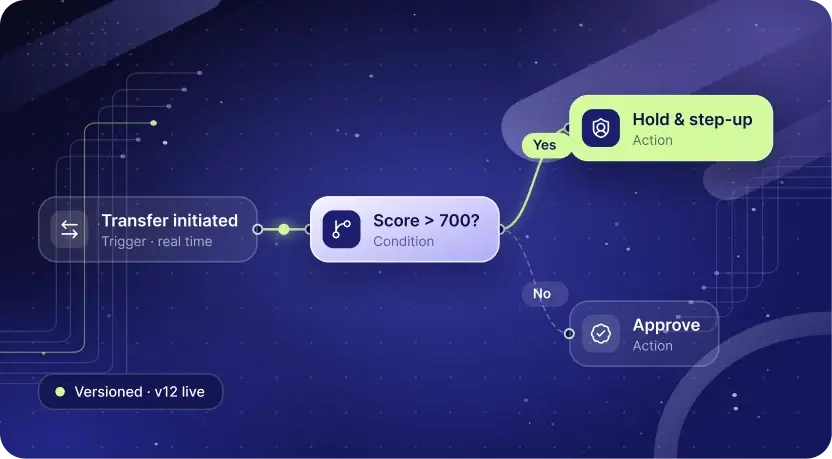
Change a policy without filing a ticket.

Inspector

Investigations that start with context, not a transaction ID.

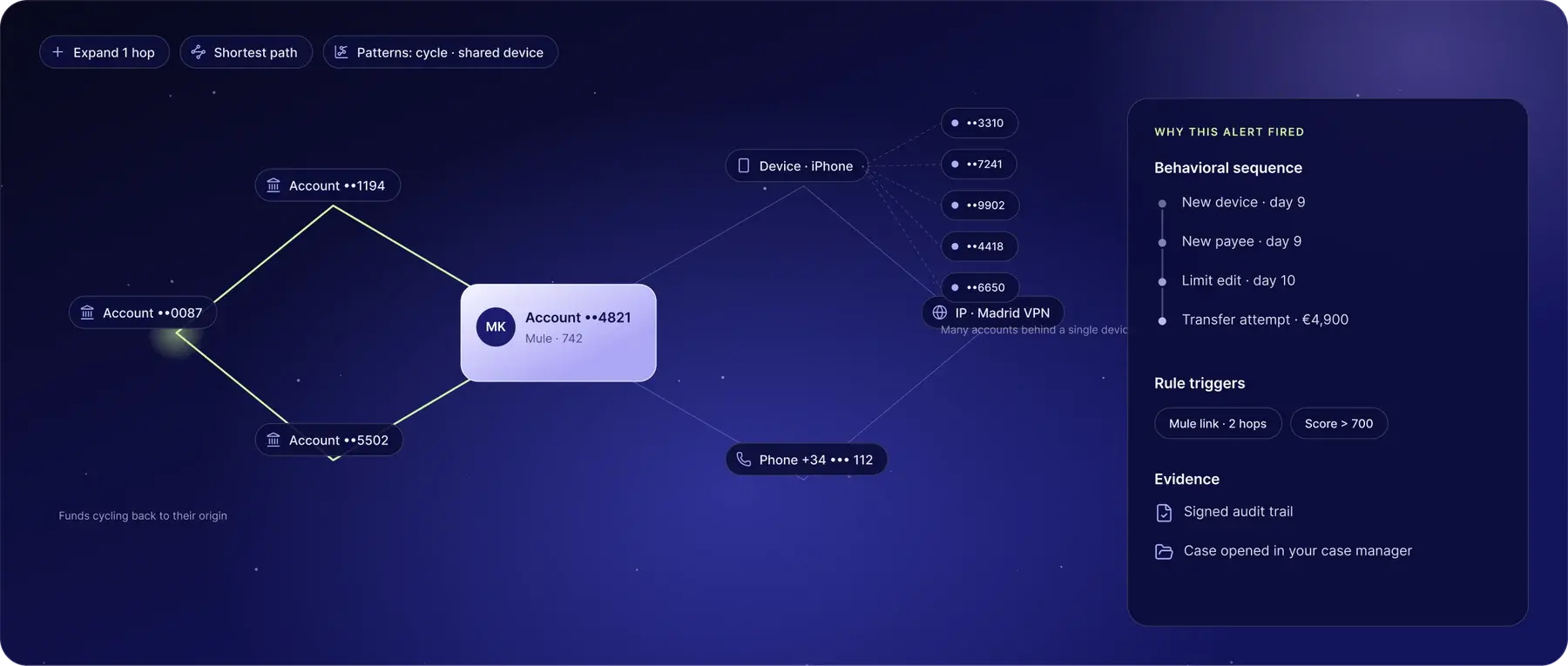
Inspector brings classifications, alerts, policies, and signals together. Dashboards, real-time alerts, and investigative tools span every channel and source in a single console, so analysts see why an alert fired and what to do next.

Inspector: link-analysis graph around a mule account with the behavioral sequence, rule triggers and evidence that explain the alert.
  • Alerts and cases

    Every alert the Risk Engine produces lands in one place, and Acoru does not ask you to abandon the case management system your team already uses: its alerts open, update, and close cases inside your existing workflows. Investigation outcomes feed back into the Risk Engine.

  • Link analysis

    Link analysis puts relationships on a graph: accounts, identities, devices, IPs, phones, and the movements between them. Analysts expand one hop at a time, trace the shortest path between two entities, and surface the shapes that signal organized fraud, such as funds cycling back to their origin or many accounts behind a single device.

  • Evidence and audit

    Every classification carries the behavioral sequence and rule triggers that produced it, with links to the evidence. Every event, score, policy, and model execution generates a signed audit trail, exportable for internal or regulatory audit.

AI Assistant and AI Workforce

Analyst support in natural language, and autonomous execution within your limits.

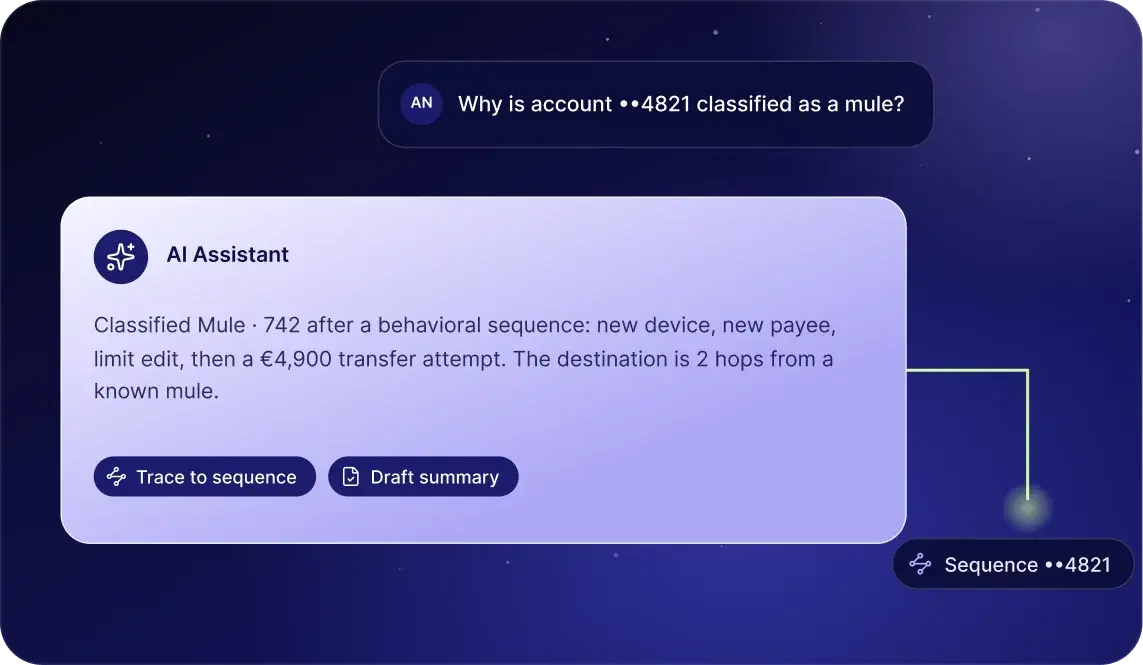
  • AI Assistant answering why an account is classified as a mule.

    AI Assistant

    The AI Assistant works alongside investigators across the Platform: account risk queries in plain language, investigation summaries, rule and model assistance, audit-ready reporting. Every response traces to the behavioral sequence behind the classification.

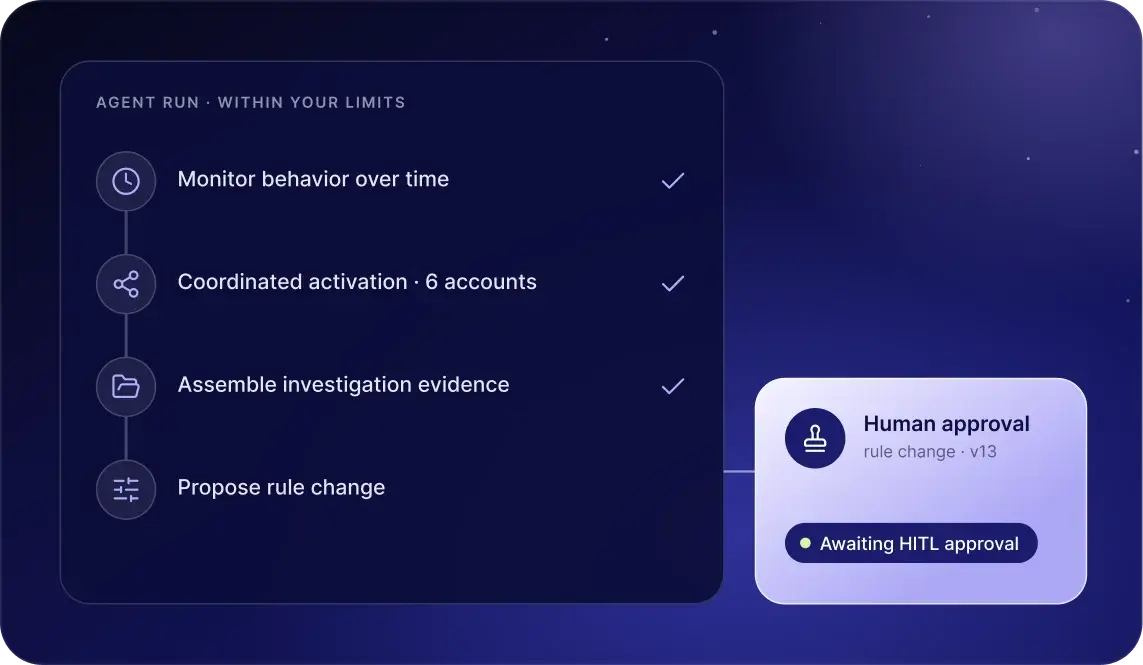
  • AI Workforce run: monitor behavior, coordinated activation, assemble evidence, then human approval before a rule change.

    AI Workforce

    The AI Workforce brings agentic AI to fraud operations. It runs multi-step workflows without an analyst driving each step: monitoring behavior over time, identifying coordinated activation patterns across accounts, and assembling investigation evidence so analysts open a case with the work already done. Every action runs inside boundaries the institution defines, and every decision is logged and accountable.

Rule changes, model adjustments, and remediation recommendations are versioned artifacts requiring human-in-the-loop (HITL) approval before anything reaches production.

Deployment

Your infrastructure. Your data. Your control.

Acoru runs on-premises, in your private cloud, or in a hybrid environment, single- or multi-tenant. The institution decides where Acoru runs and who operates the infrastructure.

Deployment: your channels and fraud stack feed the Acoru platform inside your infrastructure, which returns results to case management and SIEM.
  • Where Acoru runs

    On-premises, in your private cloud, or in a hybrid environment, single- or multi-tenant. The institution decides where Acoru runs and who operates the infrastructure.

  • Data minimization by design

    Where intelligence is shared with other institutions, sharing is designed for data minimization and data protection: only what each purpose needs is exchanged, protected by safeguards proportionate to that purpose and limited to what is legally permissible in each jurisdiction.

  • In and out

    Ingestion runs through plug-in connectors for the solutions you already run, or through API integrations. Scores, alerts, and executed policies are pushed through queues or standard connectors into your existing case management or SIEM, or queried on demand.

Consortium Manager

Share intelligence between institutions with proportionality in mind.

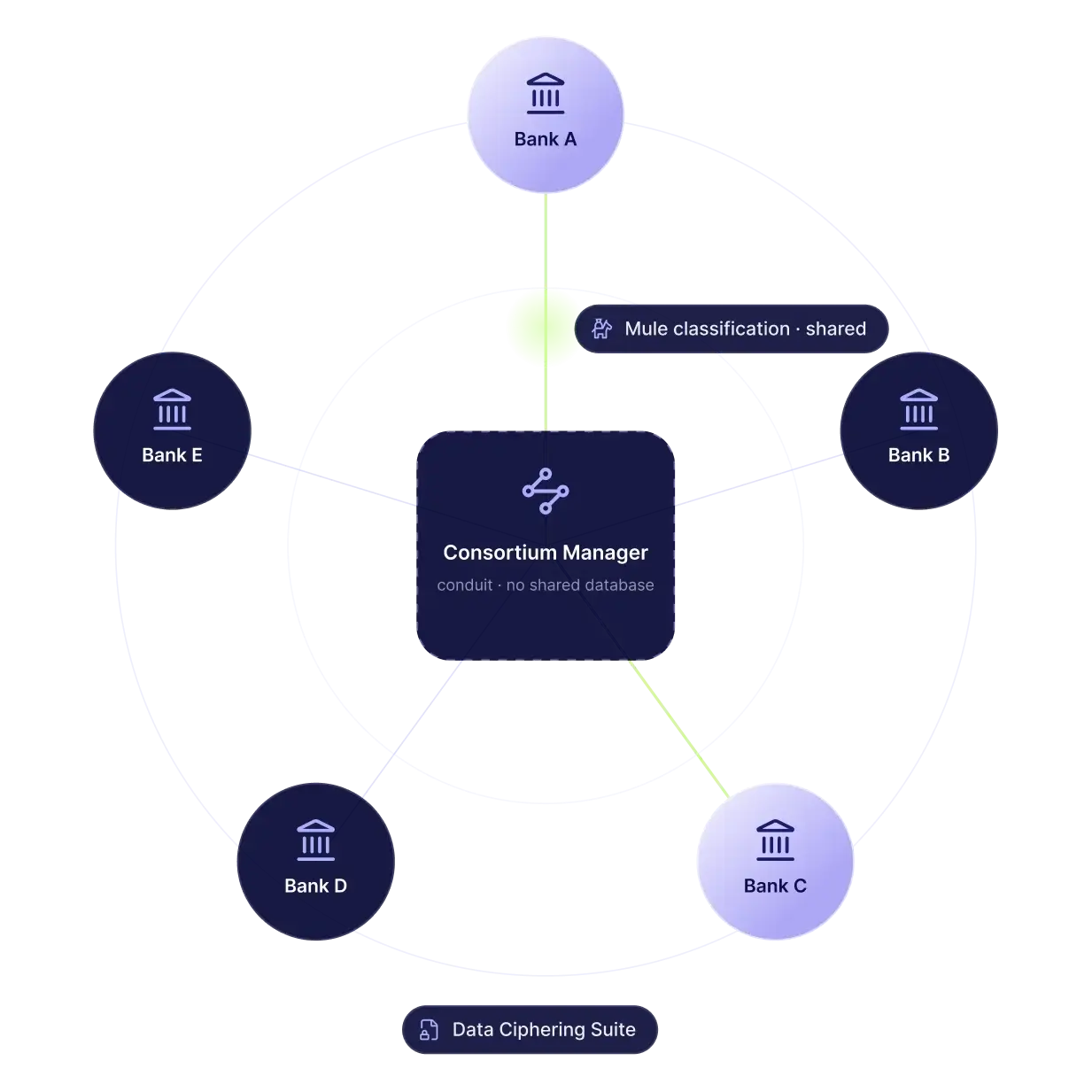
Fraud crosses institutional boundaries: scam victims, mule and laundering accounts, and the patterns behind them are rarely confined to one bank. The Consortium Manager lets banks create or join a consortium and exchange intelligence, such as patterns, signals, and account classifications. The Data Ciphering Suite protects what is shared with safeguards proportionate to each purpose, including privacy-enhancing technologies, and limits sharing to what is legally permissible in each jurisdiction.

  • A conduit between participating nodes, with no intermediate storage and no shared database.
  • Each institution keeps full control of its own information.
  • Runs as its own network layer and can be deployed separately from either solution.
  • Each member connects through its own node, whether it runs any Acoru solution or none.
Consortium Manager connecting five banks node to node; a mule classification is shared between Bank A and Bank C.

Which solution fits you?

  • Starting out or replacing legacy tools

    Holistic Fraud Prevention

    One platform for transaction monitoring, account takeover, new account fraud, scams, and mule account classification. Built to run with the team you have, with an AI Workforce that does the groundwork and analysts who make the call.

    Right for you if

    • You don't have a dedicated fraud prevention platform yet.
    • You plan to retire legacy transaction monitoring or online fraud tools.
    • You want one platform for scams, account takeover, and mule accounts.
    Explore Holistic Fraud Prevention
  • Already run transaction monitoring and online fraud detection tools

    Scam Prediction and Mule Classification

    Your stack sees the payment. Acoru sees the scam forming before it, reading the signals your existing tools already produce, adding its own, and classifying victim and mule risk across the customer journey, before a transaction is initiated.

    Right for you if

    • Authorized fraud is a growing loss line despite mature tooling.
    • Joint liability for reimbursements is a major regulatory and operational challenge.
    • You need to tell victims apart from complicit, witting, and unwitting mules.
    Explore Scam Prediction and Mule Classification
  • Extend beyond your perimeter

    Consortium Manager

    Fraud crosses institutions. Consortium Manager lets banks share fraud intelligence, such as account classifications, risk signals, and emerging patterns, so each member sees risk in accounts it has never held. Customer records stay with each institution, and every exchange is limited to what each jurisdiction allows.

    Available alongside either solution or on its own.

    Right for you if

    • The scam payees and mule accounts you need to stop bank elsewhere.
    • You run, or plan to join, a fraud intelligence-sharing network.
    • You want to share intelligence without exposing customer records.
    Explore Consortium Manager